
But, hey, Rush, if you need a ride to the airport, or some extra hands for packing, I am happy to help.
Category Archives: Words
Just Plain Wrong
What’s happening on the last Friday of the month around the world is not a really a parade — it’s the eruption of Amsterdam-like traffic patterns onto streets that were once the exclusive domain of motorized traffic. —hughillustration
Has this guy ever even seen an SF critical mass ride? It’s not a parade, sure, but it’s not a traffic pattern, either. It’s an explicit disruption, complete with rolling intersection closures. I haven’t been on one since their 10th Anniversary ride, but I put more miles on my bicycle most years than I do on my car (which has, for as long as I’ve lived in San Francisco, spent most of its time in a garage).
Here’s what I wrote about it then, in September 2002:
I had never been to Critical Mass before. I dislike riding a bicycle in a group, and it took me some time to learn enough about the political context to feel comfortable with it. I knew many people who went, and none of them had anything compelling to say about participating in it. They mostly talked about some kind of “energy.” I don’t think Critical Mass should be stopped, far from it. I just wasn’t sure what I’d get out of it.
The first Critical Mass ride in San Francisco was in 1992, and the numbers grew steadily over the months and years. It takes place on the last Friday of the month, when cyclists “take the lane” (now the entire street) in a large group, slowing traffic and blocking intersections to allow the full group to pass without a break. Since the group can number in the thousands, and the ride takes place at evening rush hour on Fridays, this creates a significant delay for drivers who are very much ready to go home.
In July 1997, San Francisco Mayor Willy Brown derided the Critical Mass riders as “lawless” and “insurrectionist” and decided to crack down on them. Estimates of the cyclists arrested ranged from 100 to 250, and there was a serious threat of jail terms for arrestees. Mayor Brown famously arrived at Critical Mass in his Lincoln limousine, and while people praise Critical Mass to the skies for forcing drivers to think about the way they threaten our environment in their single-occupancy vehicles, I’d be very surprised if those thinkers are many. Mayor Brown’s crass rage and stubborn cluelessness is still in exuberant evidence among angry drivers today (and in his own public remarks), in a city that recently saw the acquittal of a truck driver that dragged a cyclist to his death under his truck after shouting insults and throwing objects at him.
The 1997 crackdown inspired an outrage that is credited with catapulting Critical Mass into adulthood, relevance, and importance on the San Francisco political stage. It certainly changed the feel of Critical Mass forever. It was once a leaderless, almost formless event, with no specific plan except to gather on Friday nights and take to the streets. Critical Mass had already begun using mailing lists to organize before July 1997, and afterward it was made publicly known that police were monitoring the lists. There is still no official leader, although founders are often present, but now you can find your way to the start of the ride by following the increasing density of police vehicles. Routes are planned, and the police are advised of them in advance.
Last Friday, I made my way to Justin Herman Plaza, arriving right at 5:30 PM. The ride from my apartment is less than four miles, and every few intersections there were significantly more cyclists on the road with me. As we got to Market Street, there were whole blocks lined with cruisers and motorcycle cops. The Plaza was packed with people, with more arriving steadily. The ride began slowly and progressed slowly, often too slowly to keep a bicycle rolling.
The Tenth Anniversary was a big party, with a ridership estimated between 3000 and 5000. It featured costumes, art bikes, naked people, a marching band. It featured the usual run of angry drivers, clueless drivers darting out into the lines of bikes, and drivers being dutifully interviewed by local reporters. “It’s a bit rude. I feel antagonized,” the local metro daily quoted one driver. “As far as the whole bike thing goes, they ought to be working with us (motorists). They’re too adversarial.” Yeah, uh, not like car drivers. The same article reports that some drivers were delayed for as long as 20 minutes by the progress of the ride. For those hitting the Bay Bridge or 101, that was probably the shortest delay they experienced all evening.
Friday’s Critical Mass ride was planned to go up through the Haight Ashbury and Cole Valley and then back through the Castro to Dolores Park. People rode the entire route, but it was dark by the time riders were passing City Hall, and many skipped the route west of Church Street and went straight to the park, where the first arrivals were treated to a free meal. Cyclists lounged and socialized on the grass, and many remained in Dolores Street as the rest of the throng eased in, sitting, chatting, eating, and making plans to pick up take-out food locally and come back to the park.
A rhythmic sound grew from the direction of Market Street, and cyclists started grabbing their rides and moving onto the sidewalk and the strip down the middle of the boulevard. Cops in riot gear were jogging in formation down Dolores, determined to clear the street. I slipped down to 18th and headed over to Valencia. Guerrero street was lined as far as the eye could see with cruisers and paddy wagons. What, exactly, do the police think the Critical Mass riders are going to do? The most threatening shows of force and potential violence at these rides are made by the police themselves.
I doubt I’ll go to another Critical Mass, but I have a better sense of why I’m glad it exists. Like anyone, I’m ambivalent about the way it acts as a magnet for people who want to cause trouble and the way it gives a face to the anger expressed by drivers. It worries me when I see drivers who are so determined not to be delayed that they drive right into the ride. I wonder what the true proportion is of drivers who see Critical Mass up close and actually start thinking about transportation issues, even as I realize that’s a small part of what makes Critical Mass important.
I talked to people on the ride who never commute by bike, because it’s too dangerous, but they were out for Critical Mass. I want them to feel like they can ride a bike to work or let their kids ride to school. Political change is effected by many efforts; it’s not enough to limit activities to bicycle-safety classes for kids and work with legislators. I don’t like the odd bicycle messenger running amok any more than anyone else — probably less — but I understand why they’re angry. The streets will never change without events like Critical Mass to help maintain pressure and improve awareness of this traffic that gets pushed to the side of the road.
Since then I have been shouted at and nearly clipped by Mass riders as I’ve walked nearby, I’ve been surrounded by Mass riders slapping my windows when I had the misfortune to be in my car along their route, and I’ve learned that it’s best to just stay the hell away from wherever they plan to be on the last Friday of the month.
I’ve seen other countries’ diverse transportation cultures first hand. San Francisco doesn’t have anything remotely like Amsterdam (or China or India, for that matter), although it’s a somewhat safer city for bike commuting than when I wrote 8 years ago. But I’ve seen that mainly in the change in allowed traffic on Market Street – with much less private car traffic, it almost feels safe on the way to work now.
I would LOVE to see SF develop a city transportation culture like Amsterdam’s, but that takes more than idealists engaging in scheduled demonstrations. It takes (among other things) committed leaders and planners who have the courage to reduce automobile access to streets and create specific, protected areas that are bike only – and that provide meaningful access all over the city. And those efforts are not helped by delusional claims about a monthly, rush-hour bird-flipping to everyone else on the road.
The Walled Garden
Does anybody remember what using a computer is like? I spent a week after reinstalling my operating system picking out the right tweaks and gizmos and gadgets to make things more manageable. Weblogs exist that do nothing but teach you how you can make your experience on a computer less shitty. On a closed system, you can’t do that. You work with what you’ve got. —Rory Marinich, “I Love Walled Gardens”
Marinich goes on to extol the virtues of having a sandbox to start in instead of having an expert system that must be learned before you can make anything. He’s absolutely right – not least because lower barriers to entry mean more people will experiment but because the more people who experiment, the broader the range of potential creations are out there, because that broadens the range of itches that people will discover and be inspired to scratch. (Besides, expert users who want to root around on the insides: isn’t that what the dev kit is for?)
He speaks harshly about the role of compulsive behavior in the environment in which people often define success in computing, but it’s impossible not to nod along with him, especially after another Apple release cycle. He is spot on about the people who speculated wildly, overexamined every leak, made elaborate laundry lists of every little thing a new Apple product should do, and then freaked out when Steve didn’t deliver exactly what they imagined. I happen to enjoy watching that particular parade unfold, but it seems like an agonizing place for the people marching in it.
And they must be getting tired after making the same complaints over and over again for so long.
LIES
One thing Sweethearts lovers can count on each year is the candy’s simple formula. Since the hearts inception, the recipe has remained basically unchanged. —NECCO® Sweethearts page
For decades one of my very favorite things has been the chalky confection known as the conversation heart. NECCO makes the good ones; I have no interest in the Brach version.
Until this year. I went to the local drugstore, and the packaging was utterly wrong – all opaque, no view of the candy. And it smelled wrong. Not, like, up close, but from a distance. Like Sweethearts Tarts. I looked for citric acid in the ingredient list, and no dice. I bought a small box for experimental purposes. Gross. Not just the wrong taste, but bumped flavors for the different colors, like someone overdoing the saturation on a photograph and ending up with colors that are just plain odd.
They issued an egg style of the candy for Easter a couple years ago, and they were absolutely foul. These are not as foul as those were, but they are NOT the traditional NECCO Sweethearts. And I don’t have the heart to try Brach’s this year and see if those are an acceptable port in this storm.
Valentine’s Day is cancelled.
Update, Feb 2014: My local grocery sold these during Valentine season as bulk candy. I also found an almost identical formula in individual boxes branded BRACH, but the BRACH-branded bags were different. It makes me crazy these are still manufactured but so arbitrarily marketed. I can’t be the only person who bonded so hard to these in childhood!
After the End
Daniel Golden, former WSJ writer: One of the tragedies of the sale of the Journal is that it never aroused the public outrage that the sale of the New York Times would have, right? I think people looked at it and said, “Big deal. A right-wing tycoon is buying a right-wing newspaper.” But the reality was that for those of us in the news operation it didn’t feel like a right-wing newspaper. It felt like a great, independent, muckraking, thoughtful news and analysis operation that played an indispensable role in American society. People who weren’t familiar with the paper didn’t realize it was an awful lot more than an editorial page.
At the end of last year, family members, staff, ex-staff, and several anonymice remarked on the sale of The Wall Street Journal to Rupert Murdoch. Daniel Golden in particular says a lot of what I was thinking as I watched the sale and have watched the paper change—particularly becoming more diffuse and less interesting in its coverage. Also, I can’t quite believe I just linked to GQ.
Atul Gawande in San Francisco
Tonight I heard Atul Gawande speak about the issues in his new book, The Checklist Manifesto. He led with a case report of a 3-year-old girl who fell into a frigid lake in Austria and was not only revived, after many patient interventions at a local hospital, but was restored to normal function over a period of regular therapy. He then discussed the development and hitches of the WHO project to develop a checklist for surgical procedures that could consistently improve the safety of surgical procedures.
Gawande is an engaging speaker, with a calm and quiet demeanor that must be immensely reassuring to his patients. I have met a lot of surgeons, and they aren’t always as nice to their coworkers as they are outside the hospital, but he clearly gets it: checklists don’t just enhance safety and improve outcomes, they also provide support for any team member to say, hey, wait a minute, is this right? Gawande reports thinking, even as he embarked on this project, that he didn’t need to use checklists himself. After all, these lists were intended to improve care in developing nations; he was at Harvard. But he used them anyway, and they improved outcomes. He seems to embrace the way they democratize the team, too, fully understanding the significance of one the items that got the most resistance: that everyone introduce himself by name. And that most team members in the operating room used first names, but surgeons don’t.
As a person who’s done some rock climbing and who has flown in a friend’s single-engine plane, I don’t find the idea that a checklist is important to be new – and this applies not “even” but especially to experts, who are somewhat prone to presumption. It’s almost a little absurd to think of an individual assuming that he personally (and in surgery, more than two-thirds of the time, it’s a he) knows so much about everything that can happen in the operating room that he can afford to be dictatorial, and not even know his team member’s names. This seems obvious in medicine, which has changed so much during the careers of still-practicing surgeons. But it is illuminating to learn that airplane pilots had to come around to checklists, too, beginning as surgeons have with highly heirarchical teams that they directed with little opportunity for questions.
A couple of European countries have reported full adoption of the WHO-sponsored surgical checklist, but Gawande told us that in the United States, uptake is around 1 hospital in 5. It is wrong to suggest that doctors don’t understand as well as airline pilots that lives can be lost if they make a mistake, and yet it’s not enough to note that it’s expected in medicine that some lives will in fact be lost, and that’s nobody’s fault. I was struck by one particularly big difference: a pilot or a climber is also at risk of death if they make a mistake or miss something – a risk most surgeons don’t face in the operating room. I hope that’s not what it takes to make American surgeons use checklists.
The Disney Aesthetic
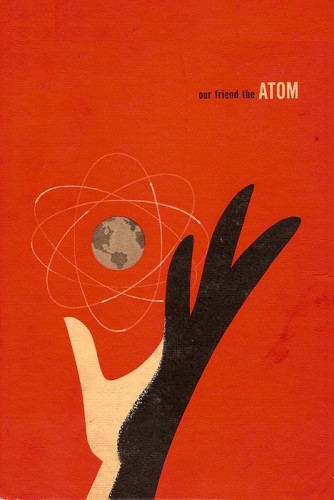
This is the cover of a Disney book from the mid 50s (56-57), companion to a short film. I haven’t seen it myself, but I’d like to. Matt Springer describes it:
It’s one of the things that made me so interested in physics. Well, actually I suppose the cover looks more Russian Constructivist, but I’m no art critic. The interior contains a solidly Art Deco inspired Futurist aesthetic. That’s what today was supposed to look like back then. The science in the book is quite solid as well. In fact, I’d like to scan some of the pages and write a series of posts on it. It really did manage to inspire a sense of wonderment, which is pretty amazing for a book about the history and applications of atomic physics. Will we ever see that kind of optimistic vision of science again?
I think …
I think I want my next car to be a Tesla (the car car they are developing, not the sled they are marketing now). What does this say about me?
Dangerous
You’ve probably heard either a lot or very little about the Sidekick failure. At the beginning of October, on a Friday, T-Mobile Sidekicks lost contact with the servers that support their data functions, and those services were completely unavailable until Monday morning. During the following week, some improvements were made, but the service was not back to normal. A full week after the initial contact loss, Microsoft acknowledged that personal data had been lost, and the party line was that a hardware switch-out was to blame.
A failed hardware switch-out was always a lunatic story. When hardware fails, you replace the hardware and install any relevant backups. The Sidekick service had run for years without any issues even approaching this, so what happened here? And for that matter, if you but dimly remember hearing about the Sidekick back when it was the It Device, what does Microsoft have to do with it?
What Daily Thing? There Could Be Life Out There!
Last night I took a night off, and tonight I did, too, but I at least got out of the house. I joined Kishore Hari’s Down to a Science program for tonight’s presentation from Seth Shostak of the SETI Institute.
Shostak talked about the history and mission of the SETI project, and took lots of questions from a largely excited and completely sympathetic audience. I can’t really do justice to Shostak’s talk. If you’ve followed SETI at all, frankly, there was not a lot of new information, but I hadn’t quite realized what an engaging speaker he is ad lib.
And he took potshots at dolphins, Neptune, San Mateo, college education, the impoverished prisoners of the 4 dimensions we experience, people with navels, AND the post office. I mean, in a nice way, but I can’t help saying, you know, the post office has a really hard job. It’s like DNA, when you think about it, especially if you really love your Netflix subscription, as I do – so many things can go wrong it’s kind of amazing what a good job they do.
Anyway, if you get a chance to see him in an interactive environment, go!