Category Archives: Words

Resisting the Urge to Make a Lame Pun on “Burn”

Burn Notice debuted on the USA network last summer to a fair bit of buzz, none of which I was aware of, because I don’t have cable and don’t follow the new releases. Recently some friends were talking about which cable shows were worth catching up with, and someone mentioned this one. It has Bruce Campbell in it, so I decided to give it a try. I ended up watching the entire first season in 2 days.

It’s charming and light – a fantastic pastiche of spy novels, American detective stories (especially the Florida-based stories of Carl Hiaasen), tv crime procedurals, and, well, MacGyver. Plenty of shots are fired, and plenty of things blow up, but the action usually doesn’t happen until after a trip to the hardware store. (It’s not just common household objects that are drafted; fondant icing is used in a way that will amuse anyone with mixed feelings about that substance.) Regular narration by main character Michael Westen – a US-agency operative turned private contractor who’s been abandoned by his (government) clients – provides a surprisingly pleasant level of exposition. The hardware-store-first ethos is matched in episode resolutions that have more to do with tricking tricksters, setting bad guys upon each other, and other forms of sweet justice rather than plain vanilla taking down.

The Westen character is anchored by an ex-girlfriend, his mother, and a friend who is a washed-up former covert operative. Gabrielle Anwar is a little too kooky for me as the ex-girlfriend, and her accent is basically a case study in how not to do whatever accent she’s trying to do. His mother is played by Sharon Gless, of Cagney & Lacey fame, and there is at least one major nod to that series in season 1. The washed-up ex-operative is played wonderfully by Bruce Campbell.

I still don’t have cable, so I haven’t seen any of season 2’s episodes, but I will. Its nice combination of a big story arc with compact, episodic stories, and its overall sense of great fun almost make me want to read all about it at Television Without Pity before I get my hands on the new stuff.

Almost.
Raptors

Yesterday on my bike ride, I saw another person in a park gazing awe-struck at a raptor. This is the third time in a couple of weeks I’ve seen this. I’m in favor of anything that causes someone to stop and recognize the immediacy of nature, red in tooth and claw, but they seem to gaze with a reverence that is usually reserved for rarity. Raptors are not rare in San Francisco – several kinds of hawks are very successful throughout North America, except in the high arctic and in unbroken forest, and the Bay area is both a good place for raptors and right on a major migration route.

The red-tailed hawk, which is sighted thousands of times a year according to the Golden Gate Raptor Observatory, is considered a “least concern species.” In some ways, human development has benefited these and other hawks, by giving them poles to perch on and a mix of cleared and standing trees to provide hunting grounds and nesting areas. The Cooper’s hawk and the sharp-shinned hawk are the other most commonly sighted hawks here, thriving as they do with access to a mix of clear and wooded areas. The sharp-shinned hawk sticks to denser tree cover than some of the others, in part because this smaller hawk is sometimes preyed on by Cooper’s and other larger raptors. Ospreys – though not a common sight in San Francisco – are regularly present and also considered a least-concern species, in spite of some having been threatened by widespread use of insecticides such as DDT in the middle of the last century.

Around Lake Merced and in Golden Gate Park, raptors often keep an eye out for little rodents and other small mammals on the ground. Yesterday’s bird – a red-tailed hawk – was sitting on top of a streetlight, scanning around the road toward the golf course beside Lake Merced (perhaps thinking that if that runner kept staring, frozen, it would eat like a king that night). I’ve seen hawks successfully grab a meal in the park, too – once, memorably, mere feet away from a toddler that was excitedly babbling to his mother about the gopher that had just peeked out of its hole.

The Golden Gate Raptor Observatory conducts counting and banding activities every fall, educates the public about its activities, and reports its findings about raptor populations flying in the Bay area. Donors receive an annual newsletter and season sightings summary.

Seven(ish) Things I Have Been Enjoying Lately


Two of a Kind

Appalachian Journey and Appalachian Waltz – Yo-Yo Ma, Edgar Meyer, and Mark O’Connor

Blueberries

The 30th Anniversary Edition of The Selfish Gene, by Richard Dawkins

Bike rides in San Francisco – through Golden Gate Park, along the Ocean, out Skyline, around Lake Merced, over to Fort Point

Mad Men, Deadwood, and The Adventures of Brisco County Jr

Old National Geographic magazines

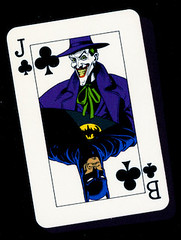
… and BatmanYear One, The Dark Night Returns, The Killing Joke, Arkham Asylum: Serious House on Serious Earth, Prey, Night Cries, The Long Halloween, and The Man Who Laughs

Rescue Me

I live in my current apartment but instead of a U-shaped hallway around a stairwell, it has one long hallway to the back of the building with a single door leading to a back yard and patio. Some of the neighbors leave the door open, reasoning that the back yard is fairly secure. We let our pets out there.

My next-door neighbor is a movie buff who collects weird things that had belonged to the stars. She works in a law office or maybe some kind of political organization, and she isn’t home very much. I work at home so I can spend a lot of time outdoors during the day. Sometimes my cat takes walks with me.

A mountain lion had started hanging around the building. It is large and black. Sometimes it stretches out in the street or on the sidewalk outside the building. I wave my arms and yell whenever I see it. I stop letting my cat out. If he whines a lot when I go to the door, I tuck him into my shirt instead of letting him walk on his own. Soon, every outing involves seeing the mountain lion, and because we are in the middle of the city, the Park Service refuses to come and remove it.

I come home one day surprised not to see it in the street. When I get inside, I see it in the hallway, lying on the floor between my door and my neighbor’s. She is at work, and I go there to return her keys. She works in an office that circles around 2 sets of escalators and takes up several floors. She is avoiding me, and I keep catching little glimpses of her from the escalator well. The receptionist tries to track her down for me, but although she is extremely competent, my neighbor eludes her as well. Finally we speak. She says she doesn’t understand why there is a problem and repeatedly asks me to keep my voice down because she is at work. Whenever I start to give her the keys, she pushes my hand away. She talks to me for a few minutes at a time, then vanishes, then reappears, over and over.

I go back to our apartment building, still with her keys, and our hallway has been transformed into a garden courtyard. Another neighbor is crouching down, reaching out to the mountain lion, making kitty-kitty noises at it. I scream at the neighbor, grab him, and push him behind me. Then I wave my arms and yell at the mountain lion, walking toward it on tip toe. The mountain lion does not move.

I open the neighbor’s front door, and the mountain lion brushes past me, leaping into the apartment, where it finds a filthy life-size doll representing a child of about 6 years old, lying in the middle of a main room cluttered and stacked with memorabilia. The doll has human hair on its head, delicately painted features, and one remaining eye. The mountain lion rolls around in the small clear space with the doll and then drags it by an arm out of the building through the back yard and disappears.

I Dated a Cop

He was a good-looking man, in that brawny, sharp-eyed Nordic way. He’d grown up locally, in the Scandinavian neighborhood, near where I lived, where there’s a Lutheran church on every corner. His dad had been a fisherman, but that life wasn’t for him. He joined the police force out of high school, married his childhood sweetheart, and had two kids by age 22.

When I met him, he was 30. He’d been promoted and divorced. He was working on the bachelor’s degree that police officers get when they want to be promoted again, in “SoJo” (“Law, Societies, and Justice”). From the very first day, he sat beside me in Hindu devotional poetry class.

We read songs of Krishna and of Kali. The professor enraptured our small class with lectures and slide shows about cultural context and the art that illustrated, adapted, and alluded to the poems we were reading (in translation). It was a quarter of passion, reverence, earthiness, and transcendance. Heady stuff for lonely people.

He walked me out after class from that very first day. He often carried my books. We had coffee or a quick lunch before we went to our respective jobs. I was a returning student, too. He could relate to me. He could be honest with me. Not like these kids running around underfoot; they had no idea how hard life was. Sometimes he dropped me at my office in his ancient, beloved (but not suspiciously so) BMW, which was always illegally parked. Absolutely always, as if he saw a legal spot and an illegal spot side by side and chose the latter every time.

He was angry about things. He was angry that he felt pressured to go back to school. He was angry that he was expected to pay for parking. The divorce had been ugly, and his ex-wife was no longer in their children’s lives. He was very angry about that.

He was especially angry about the isolation he felt, having almost every moment of his day scripted by work, school, or his children’s activities. He loved them, don’t misunderstand, but he was overwhelmed. Like many overwhelmed people, he had a hard time accepting that there just wasn’t enough time. He could not simply be a good student, work toward the next step – the next three steps – in his career, and then be the best dad he could the rest of the time. Something was missing, and he felt entitled to it, and if he didn’t have it, it was someone else’s fault.

“When you’re a single parent, you can’t meet anyone. No one wants to get involved with someone who already has kids.”
“I don’t know. I like kids.”
“Where the hell were you five years ago?” He didn’t say it in a funny way.

I caught myself wondering, even though I knew I hadn’t been in the right place for him. I was a returning student, but I had only worked for a couple of years. It wouldn’t have hurried his promotions to be picking up his girlfriend at the local high school. I’m sure that never occurred to him. Unless it did. Maybe he just needed a good babysitter.

Nothing Happens Unless First a Dream

I have 2 kinds of dreams: extremely simple, literal dreams, usually about work but sometimes about fun stuff (I have dreamed depressingly long, ludicrously realistic sequences of Civilization turns), and genuinely weird, complicated dreams that almost always revolve around a living space. Lately I’ve been trying to be more aware of them, and at least make a couple of notes to myself even about the literal ones, because I wonder if there’s a pattern. Is my dreaming meaningfully related to food, regular exercise or sleep (or the absence of them), stress, notable events? I know there are some patterns – I’ve had unpleasant recurrent dreams when I’ve been depressed, for example, but those are as simple and obvious as literal dreams about work or other activities. What I really want to know, of course, is whether there’s anything I can do to make it more likely I’ll have the kind of dreams that leave me thinking, “Where did that come from?” In a (mostly) good way.

Here is one of my most vivid such dreams, from July 2003. I still think about this one because of the ducks. I do a lot of bird photography now, and my stepfather raises ducks and chickens, but this was a period when I didn’t think much about birds at all, although I was about to. I hadn’t even started watching The Sopranos yet.

I was in a little apartment with a front door onto the street and a back door onto a balcony with a yard below. I knew the neighborhood. It’s the one I lived in when I was in middle school, in Seattle, although it didn’t have any structures on it like the one in the dream. Actually, I got dropped off there that night, after a movie with my last boyfriend and a friend of his, a very close friend of his that he never introduced me to until after we broke up, and when they pulled up to the front of “my building” it looked totally different from the way it looked when I looked out my front door.

As we pulled up to the building, it was a fairly standard San Francisco apartment building, with a careful paint job and big bay windows in neat columns. From inside, it was a strange mix of elegant Asian design and junky 50s dark wood and stained glass in a range of colors reminiscent of amber. I had an enormous window next to the sliding-glass door for the balcony, and that window had only a screen, no glass. It was easily 6 feet high and 8 feet across. I remember looking at it and thinking, “That doesn’t seem very secure.”

The dream fragments are from just before and just after the movie. When the ex drove me home, he was also hauling a bunch of my things, things I had had with me, not things that I’d left with him, but an awful lot of things. It took two trips to get everything into the house, and there were three of us. I flashed back and forth between primping the place before I left and trying to put things away right when I got home with all this new clutter. The apartment was stuffed with things I had recently acquired from one place or another, including an intensely uncomfortable stool-like chair, with a bent-wire back, that I was trying to mitigate with an embroidered pillow.

I looked with frustration at a pile of junk in a bag that had burst open when set down on the floor. I knew I had to put these things away quickly, or my cat would play hockey with them. When I knelt down to start sorting the contents, I saw a duck near the fireplace, a brilliant male. I leaned toward him and caught some movement in the corner of my eye. A dull, brown-feathered female with what appeared to be a chick. I felt sorry for the ugly duckling.

I picked up the chick with ease, and the mother didn’t seem concerned. She walked over to me, and I petted her back. As I did, she lay down flat on the floor and I saw she had orange, not brown, coloring, and tabby stripes. She was, in fact, a cat. I looked up at the front door, and there was coming a steady procession of chick-ducklings with their dull-feathered mothers joined by tabby duennas, a half a dozen, now a dozen or more.

I explicitly remember thinking, “Oh rats” (in the interjectory sense, not as a simple observation) as the alarm went off.

Right now I have another reason for trying to capture these images. I am preparing for the Three-Day Novel Contest, which runs over Labor Day weekend. I do this every year, either as a personal writing retreat or as some kind of orgy of self-scourging, I’m not really sure. Even when I don’t have a good time, I learn something important, but it’s always more satisfying if I at least have some idea in my head about what to write by a comfortable few weeks beforehand. (It works if I change my mind at the last minute, too. There’s just something helpful – reassuring? – about having a concrete plan.) And so I am scouring my dreams, hoping for inspiration.

A Day’s Work

In this dream, I was working for a guy who was a slight kook but on to some genuinely spooky things. I can’t remember exactly what they were, but they were strange scientific phenomena, not paranormal or supernatural things. I organized information in the office. It was a long, narrow space with lots of desks that were only half as deep as normal desks, but the office was almost paper-free.

An old flame came to visit me at the end of the day. We walked out into the street and looked in windows and stopped somewhere for tea or something (I can’t quite remember). It was dark when we finished, and he offered to walk me to my car. I remember thinking how strange it was that he was shorter and thinner than I am now (in real life, he is solid and much taller). He was wearing large round glasses.

My car was in some funny spot in the parking garage that required a lot of walking around. As we walked, he started dropping things, a coat, a bag, then his hands, hair, even his (in this small incarnation) pointed and birdlike face. When we got to the car he was his (bigger, real) normal self again.

Later (not sure how much later), I was on the bank of a river, and the man I was working for was in the water, almost chest deep, holding a woman at the water’s surface with one arm. He too had removed his hair and face but just looked different – a handsome, gingery, bearded man where he had been dark featured and more pointed before. I didn’t recognize the woman, but she looked (Asian) Indian and was wearing a long, full skirt and a light cotton top. He pushed her top up with his hand, and then drew the tip of a knife in a long, graceful curve over her lower belly. She smiled.

Though you cannot fully know yourself, make an effort to detect your biases

Juliana Gallin hosts a monthly science cafe in San Francisco called “Ask a Scientist,” in which local members of the science community give a brief talk on a topic of interest to them and then field questions. It’s not always the speaker’s main focus, as in May of this year, when Berkeley vision scientist Ariella Popple spoke about broader issues of sensory perception, but the subjects are always interesting, and Gallin has built an appealing series with her curiosity and instinct for producing.

Wednesday night, the subject was “Native science,” and two speakers shared the stage: Rose von Thater-Braan and Isabel Hawkins. Thet worked together at Berkeley, where they met in the 90s. Hawkins is a research astronomer, and von Thater-Braan is a little harder to pin down. She seems to be a combination educator and corporate coach, but the CV published at her website is more of a biographical sketch, and it’s not immediately clear exactly what her path was to administration in a Berkeley astrophyics program (until 2000).

Nominally, Wednesday’s talk was about indigenous peoples’ methodologies for developing knowledge bases and how the Western approach to science can gain from a culturally competent understanding of those methodologies. So far, so good. But the result was an unhappy freighting of some words and insufficient precision with others that made it hard to take claims seriously. “The seriousness of environmental issues, a language bridge provided by the quantum world and the existence of a generation of Indigenous [sic] scholars has [sic] fueled the confluence of native and western epistemologies and revealed an emerging vision of a 21st century scientific paradigm.” So begins von Thater-Braan’s description of her Native Science Academy. In the course of the talk, “quantum” seemed to be invoked to yoke a supernatural, animist worldview with the hard sciences. “Empiricism is a first-order approximation [of indigenous science],” notes Hawkins, but von Thater-Braan steps in to stay that this observational foundation relies not only on the conventional senses but on the “metaphorical senses,” to access the spirit and energy that animate all the matter (and other phenomena) in the universe.

von Thater-Braan is Tuscarora and Cherokee, but most of the native science under discussion was Mayan because of the talk’s focus on astronomy. This lack of unity increased when the questions came out. Did the Mayans, with their superior sky knowledge and calendrical systems, understand that the earth was round? Yes, says one of the speakers. (No effort was made to address the difference between a disk and a sphere.) They believed the earth was a square, says the other. Indigenous science is based in the land, von Thater-Braan says. Except for Polynesian science (navigation), which is based in water. Polynesians could navigate the Pacific without timepieces because they used chants to keep time, says Hawkins. Really? Was this superior to their documented techniques of meshing stellar navigation, ocean current and swell observation, and observations about bird behavior – plus a probably healthy dose of trial and error?

There is a fun, anecdotal way to approach this material, and there is a satisfying, rigorous way. And then there is the way it was approached on Wednesday – anecdotal with some of the vocabulary of rigor. I’m not a scientist; in college I read literature, and my confidence in my conclusions had to be based on something other than experimental data. I have great respect for intuition, and I am comfortable with “science” being used as a bucket for various knowledge bases, without requiring “the scientific method” to be front and center. But I don’t see the value of privileging – in a sphere in which concrete answers are being sought – systems that confuse hypothesis with conclusion, that cannot distinguish between mythology and cosmology. If your “ways of knowing” can’t be tested, then how can you be sure they are illuminating rather than blinding?

Most disappointing to me was an uncritical assumption of heightened environmental awareness on the part of indigenous people, drafting the values of harmony and balance. It’s a view that strikes me as a little ahistorical in its lack of depth and attention to more pressing practical issues of geography and population. It was deepened here, though, into an explicit critique of (implicitly inherently) Western mindlessness and unsustainability, happy to name-drop the quantum without so much as lip service to equilibrium or thermodynamics, or to the elegance of seeking the simplest explanation for the broadest base of phenomena.

Alternative Transportation

Last dream of the night.

I was in a cross between Cape Town and SF – a tall hill sweeping down to the ocean, cut with deepwater ravines that had massive suspension bridges. I lived near the Golden Gate and worked near Fisherman’s Wharf. Over the hill was a shantytown of French-speaking natives, controlled by a small, white-haired woman who prided herself on her connection to white Anglo culture.

I went to the shantytown to visit a lab of sorts where small, low-impact motorized vehicles were being designed and built. Most of them were similar to recumbent bicycles but with 4 wheels. Some just looked like butterfly chairs on wheels. I tried one in the lab, and it was ridiculously fun.

The lab was adjacent to a small, secret hospital, illegal in this part of town. I discovered it when I was trapped in the lab and the end of the day, after all the whites had left the shantytown, and I was looking for a safe place to sleep. The hospital was not it; it housed growing numbers of poor locals who were coming down with a mysterious disease. The doctor believed the disease had originated in Ethiopia. The people I saw who were afflicted were losing digits one phalanx at a time, and had badly disfigured faces (essentially, lepers). The doctor was overwhelmed by the epidemic and had started limiting hospital space to those who could pay $15/day to stay there.

I left the lab and found myself in the lobby of the controller’s offices. She was being forced to cede her control, and she was screaming in French at anyone who would listen about all the terrible things that would happen when she was gone, including (where the hell did this come from?) British Airways losing its local hub.

This was not a good place to stay, so I went out in search of transportation over the hill and across a bridge to the part of town where I worked. I found a casual carpool car being driven by a small, sharp-featured man with black hair and blue eyes. There were 8 people in the carpool, and we all pushed toll money at him. He told me to keep mine, because he didn’t want to take me to work; he planned to take me somewhere else.

Rescue Corner, or How Cheap a Rationalization Can I Make for Getting an iPhone?

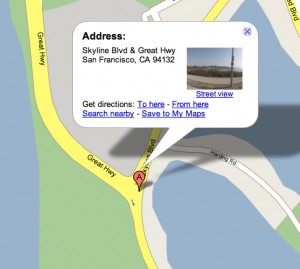
Great Highway and Skyline Boulevard

The traffic coming off Great Highway to Skyline is fast – the speed limit on that part of Skyline is 45 MPH. I’ve never seen an accident there, although I’ve been surprised not to have been a participant in one; cars cut the curve where they join very close, sometimes completely filling the shoulder, and as I see them more or less cut me off to do that, I wonder if they’d hold back just because there was a bicyclist on the shoulder.

It feels very dangerous to make that turn, but arguably it’s more dangerous to come back, where the shoulder is much narrower and often covered with plants that spill out from the embankment. (I don’t make the left onto Great Highway when I come back – I go up a little further, cross Skyline, and come back down to make a right.) The shoulder gets wider at the crest of the little hill at that intersection, and for some reason that area seems has been inviting some stops lately.

A few weeks ago, I heard a faint mewing as I crested the hill. A yowling, really, low and very distressed. There’s a big long island between the directions on Great Highway there, and I walked around in it for a couple of minutes before I located the cat it was coming from. (Hate cats? Pretend it was a dog – it won’t change the story.) She was a fat (but very cute) tortie who appeared to be scared out of her wits. She had a collar but no tags and a limp but no apparent acute distress over it.

I picked her up and held her for a little while, and she purred and nuzzled me. I carried her across the street to the only side (of the 3 options adjacent to the island) that was continuous with a residential area. She seemed unhappy when I put her down, but soon she trundled off in the direction of some houses, so I hope she was OK. (If you let your cats out and put tags with a phone number on them, someone like me will go ahead and call you up in a situation like this.)

Yesterday as I came up that little hill, I saw three people, all with their bikes upside down and all looking at the back wheel of one of them. They wanted to know if I had pliers, which I didn’t, but because the bike in distress had a broken quick-release mechanism, what they really needed was a bike shop. I am not a bike shop, but I have Google in my pocket (they only had more conventional cell phones), so although it took several minutes of somewhat arduous surfing, I was able to discover that the closest bike shop I knew of has since closed and to direct them to the next closest shop.

Just a few months ago, I’d have said there’s not much to say about this point on my ride – it’s usually unpopulated and quickly passed through. Now I wonder if I’ve been put on some kind of notice. Should I pack extra tools, kibble, and water when I’m riding through there? Should I get a phone with faster Internet connection?