
Dive Practice
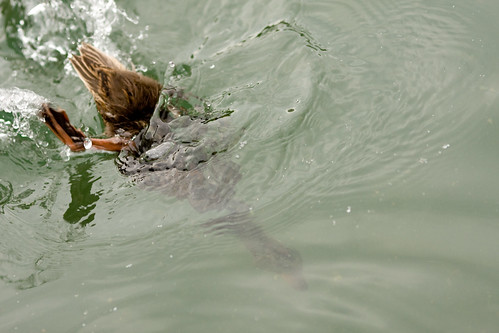
Walking down the Rainier Vista, I found this young duck with a sibling (and mom watching nearby), diving repeatedly in Drumheller Fountain.
Super Happy!
I love Scott Campbell’s work. It is whimsical and joyful. Look at this happy scene from his Prehistoric Series:
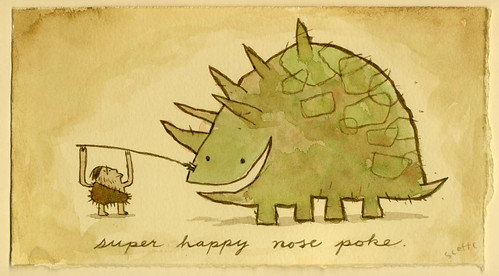
He has a show in LA right now, and prints are available. Get more information at his blog (with illustrations) and at the Nucleus Studios website.
Taking Flight

I am in Seattle for a few days to celebrate a friend’s wedding and the birthdays of two of my sisters, and to obtain some relief from the splendid isolation of my monastic existence in San Francisco.
Missing the Boat
Scenic Stones
Bill Atkinson was a member of the original Macintosh team at Apple Computer, where he designed much of the initial Macintosh user interface and wrote the original QuickDraw, MacPaint, and HyperCard software. From childhood, though, he’d been interested in nature photography, and eventually he moved out of software and into photography as a major focus. His nature photography is beautiful across the board, but the willingness of the mind to recognize patterns makes his photography of polished stones particularly compelling.



See more, and order prints, at Bill Atkinson’s site. You can also order his book, Within the Stone, at his site.
I Kissed a Bitch
From a blog post by a father who wishes he could adorn his children with a magical headband to protect them from the grotesque and misleading imagery out there in the world:

This photo (of Jessica Alba) is used in a post featuring handwringing about Katy Perry, whom this blogger believes is a real danger to girls. As he writes about Perry’s little splash in a post dedicated to considering that danger:
This is an alarming trend as the song itself promotes unhealthy relationship between same sex genders especially for easily impressionable young females. Imagine this song becoming the talk of school playgrounds, neighborhood backyards or even at dinner tables. Little girls experimenting among themselves to see whether if the song is true or not. What would you say as a parent if your daughter brings up the content of this song? Is it ok to kiss another girl? Is it normal? Is it natural?
This blogger came to my attention when he sent a request to follow my Twitter stream (I wonder why he thinks he wants to). Almost makes me want to accept – and then really start twittering. A lot.
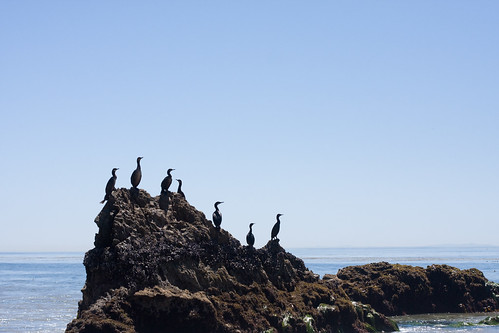
Cormorants at El Matador
Calkins on Robots
David Calkins spoke at this month’s Ask a Scientist about robots. With infectious enthusiasm, he gave a brief overview of how robots have developed, how they’re used today, and what’s likely to happen with them in the near future. “This is Ask a Scientist – not Hear a Scientist Go On and On,” he said, and took loads of questions, all of which he answered with thought and style. And he closed with a delightful show and tell of soccer-playing, cartwheel-turning robots – you know, models that prove and demonstrate useful robotic strategies.
If you think about this stuff at all, the early part of the presentation was familiar ground. We’re not talking about automobile assembly arms or the Terminator series, but Calkins clearly focused on robots doing real work and on humanoid robots. Robots are already allowing physicians to practice some remarkably sophisticated medicine at a distance, including procedures, and remote-control devices reach even further, with several devices exploring Mars today. Back home, dishwashers, Roombas, and other household devices will, he says, continue to populate our homes and handle more of such straightforward tasks. And yes, homes can expect to keep featuring, for the most part, many single-purpose devices rather than being run by magically balancing, multipurpose Rosies.
What’s next? Is it only a matter of time before SkyNet becomes aware? Calkins says no; he believes that robots will never be alive, although they will continue to have their capacities for emulating human interaction refined. Because humans like that. He’s up front that ethics is a big issue for robotics, though. One of the most interested parties in robotics development is the US military, and if killing at a distance, say, by dropping a bomb from a plane, is a little “too easy,” psychologically speaking, how about killing at a distance where your interaction with your targets is represented on a screen? Not unlike a video game – right down to the operator being at little to no personal risk.
This isn’t Asimov’s-laws stuff. Does your Roomba need know you’re human, let alone have a working definition of harm? But robots that are in a position to intervene around humans can’t use overly simple rules like “do no harm;” they may have to manage, or accurately screen for human input, issues like “which figure in this room is the hostage taker?” At a time when robots can’t generally tell a cardboard cutout of Princess Leia from the real thing, a big dose of humane thinking has to stand between a robot and a robot carrying weapons.
The biggest limits on robots in the immediate future, says Calkins, are mainly about batteries, although ethics guidelines are a big need. He sees a lot more robotics being used in medicine, naming increasingly sophisticated control of prosthetics as a promising area. He wonders aloud whether people will start lining up for prosthetics as they become better (stronger, faster) than original human equipment. He sees this as a 10-year concern, although it’s hard to imagine medicine moving quickly enough to make prosthetic placement easy enough on the part of the body where a device is attached to make elective amputation attractive.
And then there’s just plain fun. Calkins is the founder of “the only event in the world that both Geeks and Jocks agree on:” RoboGames. “It’s kind of like a weird family reunion,” says a participant in a short video posted at the website. The single-minded focus and engineering ethos of participants – taking what they have and making what they need … or really really want – helps illuminate some of the cultural reasons that this is an area that is big on working models and light on formal policy statements. “Real men don’t have hobbies – they have obsessions.”
Peeking into the Secret Garden