Author Archives: caitlinburke

Punishing Good Deeds

So if you are a live organ donor, you may be denied if you apply for health insurance later. There’s a lot wrong with this, but let’s start with the facts:

“It’s absurd,” says Matthew Cooper, director of kidney transplantation at the University of Maryland Medical Center in Baltimore. Transplant centers put potential donors through a comprehensive battery of medical tests before permitting them to give up an organ. “These patients are handpicked. They’re some of the healthiest people around.” —Organ donors may be denied health insurance

They are also heroic, supremely generous people who should be celebrated for their service to others. How about instead of punishing these people, we explicitly acknowledge the contribution they are making by guaranteeing them, oh, the same level of healthcare coverage provided to a member of the US Congress?

Placebo Success

Before the study began, researchers explained to the parents and the kids, aged 6 to 12, that the dose extender contained no active ingredient. After eight weeks, the symptoms of ADHD had grown more severe in kids who took only a half dose, but they remained stable in the groups that received either the full dose or the half dose plus placebo.

It’s very interesting to see this done with ADHD and stimulants, I guess partly because “stimulants” retain their association with recreational and addictive drug use, and “dose extenders” recall some of the ritual replacement people can use when they are trying to break a dependency. Obviously it’s only suitable with drugs with certain kinds of modes of action—it would spur the development of antibiotic resistance to use this method to “stretch” antibiotic supplies in a stressed environment, for example.

Kids in the ADHD study were told that, “the mind and body work together in interesting ways and placebos are known to work sometimes but no one knows why,” while researchers told patients in [another trial, in irritable bowel syndrome] that placebos “have been shown in clinical studies to produce significant improvement in IBS symptoms through mind-body self-healing processes.”

I like this approach, because it explicitly brings a broader inclusion of factors in the patient’s well-being into the doctor’s office. I think it has the potential to improve medical care in a number of ways, from reducing harm (potential side effects) to helping patients feel less buffeted about by what’s brought them into the doctor’s office in the first place. It would be interesting to see some of this work combined with what we’re learning about the better outcomes in people who simply comply diligently with medication instructions—no matter what they’re taking.

Read the whole article, It May Be Fake, but Trust Me—It’ll Work, which also talks about the variety of placebo effects and some of the limitations to consider before putting them to use.

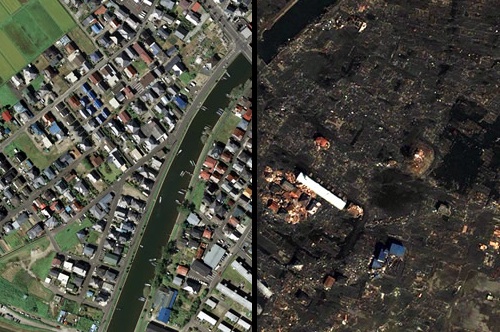
Japan

I have nothing helpful to add to the Japan story, although I’ve been heartened to see that pretty good articles giving context for what’s going on have been going up around the net. New York Times on building codes, for example, and Boing Boing on how reactors work – and fail. (Bonus: The Atlantic on how this contrasts with Three Mile Island and a NYT visualization of the buildings at Fukushima.)

And then there’s this:

ABC in Australia took aerial photos from before and after the tsunami, and arranged them so you can move your mouse across the before image to reveal the damage—and, heartbreakingly, move it back again, an option available only online.

Frozen Flamingos

Robert Krulwich was reading Ian Frazier’s new travelogue, Travels in Siberia, and got interested in the flamingos that had landed there (and then gone to live in a nearby zoo). He pursued the story, talking to more than the Siberian locals.

Marita Davison, who studies flamingos at Cornell University, says she regularly sees Bolivian flamingos up in the Andes Mountains. And at that high up — 16,000 feet — the lakes freeze around their feet. She sent us this video of flamingos stuck in ice. There are two on the right trying to get free.

“It’s really an amazing sight to see,” she told us. “They’ll just wait for it to thaw and then go on [with] their business.”

This is just a small detour from Krulwich’s exploration of the mystery.