Category Archives: Fitness

“What’s my problem?”

I’ve been collecting little bits and pieces I’ve written over and over again as people have asked me questions about food and exercise. One frustration I have with the fitness industry is that its sales focus tends to reduce solutions to THIS ONE WEIRD TRICK and other foolish formulas, single sizes that fit pretty much none, and that’s just when they’re not frankly bunk. What interests me more is teaching a person how to find the path that will work for them. Have a question? Ask me! I don’t expect to make any money from this, so I can just talk about it here on my blog, and see where it goes. Feel free to comment here or Twitter @caitlinburke.

There are lots of ways to gain and lose weight, but a single dominant feeling about all of them: that ultimately individuals just can’t control it for long.

It’s not true, of course – lots of people successfully adjust their weight and maintain it at a level they like, and there’s lots of interest in what makes them different. It probably boils down to the brain, and more specifically to beliefs, like “I believe I can accomplish this and stick with it” combined with “I know what I need to do to make it work.”

It can be hard to believe we can accomplish something even if we know what to do. Part of that comes from the wide variety of ways there are to get things done, so general principles often don’t help. Nobody seriously tells people how to make cookies by saying “Mix sugar, butter, and flour, and bake – easy,” but they don’t hesitate to say, “Eat less and move more – easy!” I believe both those things, but I’ve made a LOT of different kinds of cookies over the years, and I’ve also experimented a lot with food and exercise. And you can, too.

What does it mean to eat less?

Eating less means fewer calories in, overall. Thanks, Captain Obvious! We want to come up with something we can do – happily, every day, so we’ll have to come up with some specifics … that we can live with.

Eating is sometimes compared to fueling a car, but it’s more like budgeting. To support yourself, you need to match your means and your spending, and most of us have a basic complement of things we need to spend money on routinely – rent, food, keeping the lights on. Let’s assume we have a decent income, enough for bills + a little extra. Subtract what we absolutely have to pay out, and we are left with some money we can spend on fun stuff if we want.

Your daily intake is a budget that has to have basic components in it so your body doesn’t fall apart — so you have a place to live and can keep the lights on. Those components are a mix of protein, fat, and carbohydrate, plus micronutrients like vitamins (and, of course, water). Most people can meet those basic requirements in fewer calories than they need to keep their weight the same – eating mindfully still lets you have some fun. Where most people have trouble is in the quantities and the proportions, both figuring out what they should be and knowing when – and how – to say “when.”

What does it mean to move more?

This is both the easy part and the hard part: “move more” means almost anything. It’s walking to and from a bus stop instead of driving door to door – or at least parking at the far end of the lot. It’s taking the stairs instead of the elevator. It’s getting up from your desk once an hour to take a walk around the office, or doing a bit of calisthenics when your brush your teeth. The hardest part about this is narrowing down what will work best for you. The good news is you don’t have to have a perfect plan from the get-go, and you don’t have to stick to the plan perfectly even after you have it.

There’s a single dominant feeling out there about exercise, too – that it’s a punishment or, if not actively painful, a distasteful medicine. No wonder people are so sedentary! Your body actually likes moving around, and regular activity has good effects on almost every health and well-being measure you can look at. Most people adapt quickly to exercise if they are consistent and a little bit organized about their approach – there is certainly no one way to make progress, and if you’re just starting out, it’s even easier to get going in the right direction. There’s a million ways to get your heart rate up and get your muscles working, so you can find a few that you enjoy.

What Do I Want to Accomplish?

Occasionally I do something unusual, like an Olympic-distance triathlon just because I have the the day off, or 46,000 meters on the rowing machine because it’s my 46th birthday. And people say “How do you do that? I wish I could do that.” Maybe, but probably not – there’s no particularly great reason to do stuff like that. I think the best way I can help other people is with my complete understanding that you almost certainly don’t want to do things the way I do them. At least not in a direct step-wise fashion. But I know how I came to understand what works for me, and I want to help others start that process, too.

Here are some questions I like to help with:

  • “How do I know what I should be eating?”
  • “Is [some particular food] harmful?”
  • “I have to eat less! How?”
  • “I have to exercise more! How!”
  • “I though this [diet|exercise] would solve my problem, but I hate it. Now what?”
  • “What does that knob on the side of the Concept2 rowing machine do?”

I’ll visit and explore those questions during the rest of the month (and, I hope, keep going).

Bench Progress

Posting to my blog every day for the month of February is only one commitment I made this month. The other is do a cycle of 5/3/1, a weightlifting program developed by Jim Wendler. There are several programming volumes for 5/3/1, which you can have calculated for you at a wonderful site called Strength Standards, whose front page asks you a few questions and predicts your 1-rep-max weights for the 4 major barbell lifts: bench press, deadlift, squat, and overhead press.

I’m doing the lightest volume of 5/3/1 – just 6 sets of each of the main lifts, each on separate days. I enjoy strength training, and I’d like to have a total of over 500 lb (that’s the total of your max in bench press, deadlift, and squat). I’m close, at around 450, but I’m in no hurry. I am more of an endurance athlete by inclination, and hitting each major lift once a week is plenty for me. I am finishing Week 2 of this 5/3/1 cycle, and it suits my goals perfectly right now.


I took this photo in the Arboretum in Seattle in 2008.

Right after I graduated from college, I started going to a gym, looking to gain weight, and when the trainer asked me my blue-sky goal – something I’d always imagined but never thought I’d be able to do – I said “I want to bench press my weight.” We got me there – on a technicality. I benched my starting weight once, for 1 rep. (The real success was that I’d gained almost 20 healthy pounds.) Then I gave up the bench press.

Over 20 years later, I’ve taken it up again. There are other lifts that interest me more, and for more than 6 months, I just didn’t bother with it at all, because I could do other lifts at home but didn’t have a bench. But I got a new rack and bench last fall, and I’ve been pretty consistently benching once a week.

The 5/3/1 programming is based on percentages of your theoretical maxes, and it’s been telling me my bench is higher than my last test (in October, at 102.5 lb). So tonight I tested it again. And I benched 110. So close to that 120! But my strength is much less brittle now, and I know I’m going to blow right past it this time.

The Smith Machine

I don’t have much use for the Smith Machine. I pretty much only do triathlon sports, rowing, and big compound movements, and the Smith Machine doesn’t permit the appropriate ranges of motion for bench press, deadlift, squats, or overhead press. I’m always a little puzzled when I see one in a gym, because they are expensive, they take up a LOT of space, and the terrible experience they offer for big compound movements is not even close to justified by ‘safety’ claims.

At the end of the day, the Smith Machine is a resistance machine, and that’s why it doesn’t have much to offer people who are mainly interested in strength in context of balance and stabilization (including outdoor athletes such as myself). But there’s a whole world of people who love isolation and carefully controlled ranges of motion: bodybuilders.

Advanced and intermediate trainees only. You need to understand how to use the Smith machine correctly to derive the maximum benefit. Beginners should focus on learning basic barbell and dumbbell movement patterns and developing a strong base.

No feelers. For those who can’t “feel” a muscle working, the Smith machine is an excellent way to overcome that. The fixed plan[e] of motion allows you to really focus on the intended muscle without having to worry about balance and others factors.

From Why I Love the Smith Machine, by John Meadows.

He gives examples and sample workouts for ways to work the Smith Machine into a hypertrophy routine. Jack LaLanne invented it to be used within a regimen that included free weights (which Meadows also recommends), as a training device for novice lifters and not, it is said, with the intent of emphasizing focused mass gain. I don’t really know the merits of his argument, but my gut comes down with Meadows on this one – not for new lifters, and valuable mainly to a fairly narrow niche. If you are new to lifting, you are far better off grooving movements and dialing in form with weight as light as it takes for you to handle the safety aspect with balance and stabilization working in concert.

I belonged to a climbing gym that had a Smith Machine, and it was used regularly – people tested bench weights on it (I’ve done that myself), but mostly it was used as a rack for various kind of pullups, chinups, rows, and hanging abs work. A pretty good intersection with the (surprisingly sensible) advice in the last minute of this foul-mouthed video:

So there you have it – two carefully thought out (that video is better thought out than you think, I promise) approaches to getting value out of a Smith Machine. Something to arm yourself with in case – may it never happen – you are trapped in a gym with nothing else.

Feeling Secure

On Facebook yesterday, I saw a thread about some new drama or another in the lifting community, and someone commented, “you’d think it was all teenage girls, there is so much drama.” It probably should be more teenage girls, for what it’s worth – girls should be supported to get stronger earlier in their lives – but it also encompasses a profoundly drama-free element, popularly embodied in an article by Henry Rollins that appeared in Details magazine in 1993.

The Iron never lies to you. You can walk outside and listen to all kinds of talk, get told that you’re a god or a total bastard. The Iron will always kick you the real deal. The Iron is the great reference point, the all-knowing perspective giver. Always there like a beacon in the pitch black. I have found the Iron to be my greatest friend. It never freaks out on me, never runs. Friends may come and go. But two hundred pounds is always two hundred pounds. —From Iron, by Henry Rollins

You can quarter-rep 200 lb and lie – to yourself and others – about your relationship with the iron, but 200 lb is still 200 lb. Your buddies probably know you’re bragging about something you never did, anyway, because if you ever lift anything around other people, ever, it can be very clear what you can and can’t do.

Friends don’t let friends skip leg day. —Photo: Greg Segal/TIME

But there’s a few of those in every crowd. What’s more interesting to me is the range among lifters. As with many groups, the lowest common denominator is very low, with some particularly ugly results in a demographic that is so obsessed with testosterone. There’s also something about being undeniably strong in the most literal sense that releases the soul from its anxiety about appearance, or even urges it to adopt tie-dye socks and novelty singlets.

This guy.

There is a pure delight in lifting well, in marshaling your form so that the weight cannot help but follow the path you set for it, and in progressing to heavier weights. It is one of the simplest repayments of attention, diligence, and consistency, delightfully measurable and demonstrable to others. And it gives rise to a prominent culture of enthusiasm for the success of others as well as for oneself. The drama in the Facebook thread was all about some commercial concern among people who engage in formal competitions, but in the typical weight room, it’s mostly people showing up to get better, who are eager to share their enthusiasm with anyone else who wants to get better, too.

Update: Can’t stop dreaming of that singlet? You can buy one, along with other eye-popping designs.

“Should I eat ‘Paleo’?”

Sure, but don’t sweat the small stuff.

The Paleo diet is, in its strict form, a narrow selection of foods, specifically sourced, meant to approximate our ancestral diets. The Paleo claim is that we have not evolved quickly enough to adapt to our current food environment, so we must eat more “primally,” as we are adapted to do. The claim is oversold – we have, in fact, adapted quite a bit with our changing diets; our ancestors in the period at issue ate a wide variety of foods, whatever was available where they were, basically (both a reflection of and a continued stimulus for our adaptability); and selective breeding of food animals and plants means that the foods available to us are even less like their Paleolithic ancestors than we are like ours.
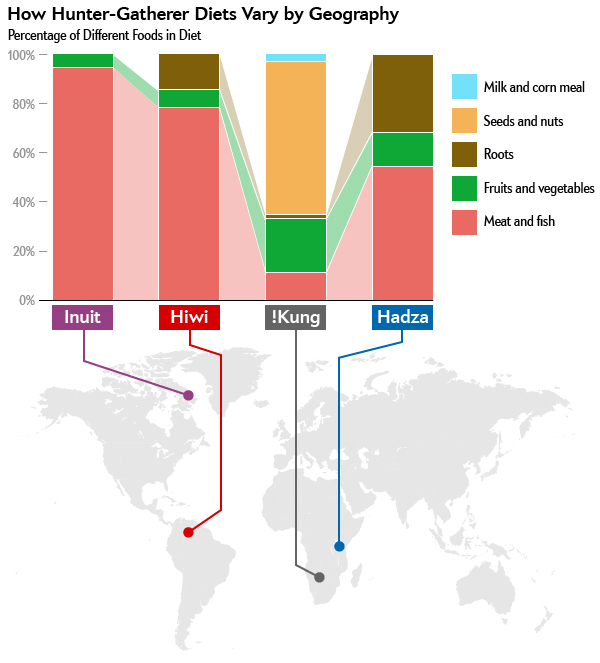

From How to Really Eat Like a Hunter-Gatherer

But that doesn’t mean you should avoid the Paleo food pattern altogether. Remember Michael Pollan’s advice, “Eat food, not too much, mostly plants”? It’s kinda like that, only more meat. The general blueprint of Paleo is a fine one: lots of high-density protein, lots of fiber-rich whole foods, and knock back on the refined/processed foods. Really nothing to argue with there. (Strict Paleo goes a lot further – no grains at all, no legumes, limited fruit, no dairy, and no sugar sweeteners, although a little honey is OK. It also encompasses recommendations for how the food is grown or raised.) Probably the worst thing about it is that its meat-heaviness and prominence of some unusual ingredients makes it kind of expensive.

If you already have lactose intolerance or feel crummy when you eat wheat, Paleo can help you organize your options, but if you don’t, those restrictions don’t have much to offer. Similarly, if you’re the kind of person who finds it hard to set limits when there’s a cake in front of you, a Paleo focus, similar to Atkins or any other high-protein/limited-carb approach, can help you build a food pattern that keeps you out of harm’s way. For most people, the most restrictive details of Paleo can be treated as mere suggestions (from a health perspective), and there are now dozens of websites discussing food options and offering inventive recipes, so Paleo can give you good ideas for how to keep home-cooked food interesting, and explore the many options outside the (processed) food industry’s heavily marketed product range.
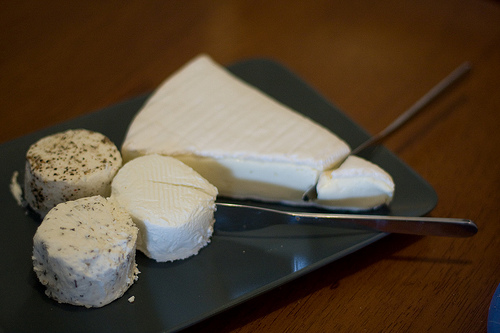

You’ll have to say goodbye to all this, though, to follow the Paleo food pattern strictly. —Photo: Caitlin Burke

What about fat?

The Paleo food pattern is pretty fatty, and fellow-traveling approaches to idealized diets claim that our primal food pattern had as much as 75% of calories from fat. (It’s doubtful humans routinely had access to that volume of fat, though.) The short version is that if you don’t already have major health issues, like heart disease or a family history of it, and especially if you exercise regularly (every other day to daily), the kind of fat present in the Paleo diet probably doesn’t matter. After all, deep-fried food is not Paleo!


In with eggs – a free-feed food for Paleo eaters! My stepfather raised the turkeys and chickens that produced these. —Photo: Caitlin Burke

The longer answer is that the same rule of thumb probably applies to most of us, too. Fat got a bad rap in the 1950s with high-profile results from studies of heart disease and the fact that it has a lot of calories, gram for gram, making it a juicy target for calorie restriction. The problem is context. In healthy people with no major risks for heart disease, especially if they’re active, fat intake is probably not that important as a risk factor by itself. And that doesn’t even get into the different adaptations of people on different foods patterns around the world (including variations in the bacteria in our guts that help us digest food). Anything can be a problem if you overdo it, but let’s take “healthy” and “active” to mean people getting regular exercise and eating a balance (not surplus) of calories overall.

One problem with “low fat” as an approach, especially as used by the food industry, is that it often goes hand in hand with “more sugar.” This is a one-two punch, because the lower-calorie benefit of the reduced fat can be undermined by the health risk of disproportionate sugar intake, AND fat acts as a “satiety signal,” helping you to feel full, so it may be harder to exercise portion control with lower levels of it. Consider the packaging for Red Vines: Always fat free! Right, because they are basically 100% sugar. Look, I love Red Vines way more than the average bear, but we all know how hard it is to stop eating ’em. (Serious question: Why on earth are candy labels allowed to tout “fat-free food” on the front of the packaging as if it’s a health claim? George Orwell would gasp.)
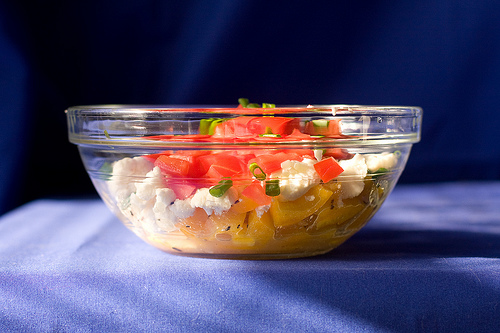

Many hyped diet plans treat sugar and other carbs like poison, but a bigger problem for our waistlines has been the way the food-processing industry has stripped the fiber out of our foods. Paleo carbs come mainly from whole vegetables, a good source of dietary fiber. —Photo: Caitlin Burke

Exercise

Exercise almost never gets mentioned enough with any hyped food pattern – some even claim you “don’t need exercise” with their plan (and I know I’ve heard that claim plenty from people on low-carb, high-protein patterns). Loren Cordain, a major, active proponent of Paleo, pushes the point that the ancestors in question probably exercised about three times as much as current US guidelines for recommended levels of exercise.

An hour a day of exercise is not as scary as it might sound – it’s not like our ancestors were killing it in powerlifting-specialized gyms or constantly training for the Paleolympics. A lot of their activity was low intensity – like walking. And if you now exercise much less than that, don’t rush it; ramp up slowly, because it’s safer, and because if you are sedentary now, every little bit helps, so you will still start to benefit right away. No matter what food pattern you choose, ultimately you should aim for average of an hour or so of activity a day (again: low-intensity activity counts), and can benefit from doing something every day. If you exercise daily because you really love to work out, make sure some days are just low-key stuff, to prevent overuse injury.

In Short

Pros: The small-p “paleo” approach is a good framework for shifting a food pattern from less healthy to more healthy. With its emphasis on nutrient-dense, satisfying foods – and its rejection of processed foods – people often find that eating this way makes it easier for them to eat more nutritiously while controlling their calorie intake. The general idea of paleo – plenty of protein, lots of vegetables, minimal processed food – is appropriate for everyone who doesn’t have a protein-metabolism disorder, you know, pretty much everyone. Also, people feel good on Paleo, an effect reported by people on other high-protein, carb-limited food patterns, too. Maybe it’s the energy bump from the protein, maybe it’s getting enough protein in the first place. And sometimes, as a social-site contact of mine remarked, it’s just that “people feel better eating paleo because before that, they had never eaten a meal they prepared themselves.” Whatever food pattern you choose, be sure to exercise, too.
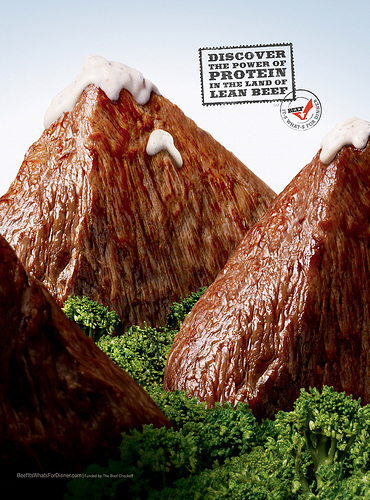

From an older Beef Checkoff campaign.

Cons: Paleo makes a lot of claims for support that are irrelevant (for example, we can’t eat as our distant ancestors did because the foods are simply no longer available) or wrong (we are evolving – coevolving with our environments – because adaptability is how we wildly successful species do it). Fortunately, we can dispense with those claims, because we don’t need to look that far to find good support for the basic idea of eating nutrient-dense food and avoiding processed food. (If you need a good counterexample, though, it’s lactase persistence. Lactose tolerance in adults seems to have developed in no fewer than 4 different ways over recent millennia – a pretty good track record for adaptability.)

Caution: Strict paleo is expensive, the foods can be hard to source, and it can be so demanding of time and effort that some people may find it sucks joy out of eating. Fortunately, in healthy people, this approach is more of an “if it floats your boat” thing than a delicate balance that must be preserved or trouble will ensue. So if it’s making you miserable, relax your approach while keeping the principles of plenty of protein, plenty of vegetables, and limited refined/processed foods.

More:
In 1975 Walter L. Voegtlin, a gastroenterologist, published a book called The Stone-Age Diet. It offered a basic structure for the Paleo movement. (It’s now out of print, with no plans for a reprinting, but can occasionally be found in libraries.)

What to Eat on the Paleo Diet, from the site for Loren Cordain’s books. Cordain published The Paleo Diet in 2002 (updated in 2010), and has published often and widely about this approach since 1997. He also points out that we should be exercising as our ancestors did – probably about triple the level of activity recommended by current US guidelines – a great idea that somehow gets a lot less attention than the diet itself.

Some Like It Paleo, a food blog by a Crossfit athlete in San Francisco. She has a list of resources, pointing to other sites about Paleo in general and featuring recipes.

The Caveman Controversy: Marlene Zuk has made some interesting discoveries about rapid evolution in animals – and has really angered some Paleo proponents with a provocatively titled book.

Debunking the Paleo Diet, by Christina Warinner – a TEDx talk, and those can be variable in quality, but this is a wonderful one – plus, what a great truncation in the link’s name!

Ancel Keys was a major figure in dietary fat in health, who identified animal fat as a risk factor in the 1950s and promoted the Mediterranean diet. His work was a foundation for the US government’s recommendation of low-fat diets.

Culprit in Heart Disease Goes Beyond Meat’s Fat reports on an interesting study showing how complex eating is – it’s not just the saturated fat in red meat that Keys pointed to, it’s what gut bacteria we have to interact with the foods themselves. This is a small detail in a growing literature about the variety of collections of gut microbes across and within populations around the world.

Go Kaleo, by Amber Rogers, a website about breaking the dieting cycle. Lots of good info about food patterns, exercise, and putting it all together in a way that won’t make you crazy.

The 4 Most Important Things about Flexible Dieting, by Armi Legge. A list of considerations for any food pattern you are thinking about, it emphasizes long-term thinking and having a food pattern you like.

Update March 2014: Don’t Fear The Fat: Experts Question Saturated Fat Guidelines – discusses recent thoughts about the cholesterol–dietary fat–carbohydrate story.

The Strange Life of Beautiful Existence

Beautiful Existence, an Issaquah woman, is setting herself a series of extended challenges, most recently completing a year in which she obtained all her meals from Starbucks.

“I felt like it was definitely something that I could do. I had a lot of support from family and friends.”
[…]
“Starbucks puts together menu items and protein bistro boxes and you know as long as you’re active and as long as you really monitor the intake of your calories, you absolutely can lose weight and I did.”

Her challenges generally involve brands – limiting purchasing to Goodwill or testing advice in Parents magazine – although she’s also done a radical budgeting challenge.

Next up: a year of REI. Sounds like fun!

Article: Woman lives on nothing but Starbucks for an entire year

I don’t read comments at news sites, but after 20 years online I can guess how comments on this article would go. The usual gendered stuff about narcissism or selfishness, maybe some stuff about the brand orientation of her challenges, and the perpetual chorus of “too much time on her hands, I guess!” that sounds whenever someone does something that requires a lot of effort and time but isn’t sports or a traditional career.

This woman is remarkably privileged to have the support of her family for these projects, which must create substantial logistical problems. As I read this story, I felt that having that kind of freedom to make this sort of commitment to an idea is, in fact, a Beautiful Existence. I have the advantage of a very simple home life, and – like most, I’m sure – find it plenty difficult to sustain complex, lengthy projects outside the basic requirements of daily life. My coping strategy has been to try to make sure I have lots of options at different levels of effort so I can actually finish something once in a while. And I doubt I’ll ever have a local news mention to show for that, let alone one that gets picked up nationally.

I wish we had more social support overall for this kind of project. One of the things that makes humans so interesting is how idiosyncratic their passions or focuses can be. Artists of all kinds can be extreme examples of this, but we all know people with surprisingly specific – and sometimes just surprising – hobbies or collections. Collecting may be a gateway activity for some people – collect … make … present, teach, convene. An “embrace and extend” that actually adds value instead of ending in extinction.

I hope Beautiful Existence won’t be troubled by the inevitable range of reactions she’ll get. People online can get so hostile and intrusive, and she’s probably pretty easy to find. I also hope that a few people will think to themselves, “OK, not sure I could do that, but a year-long challenge sounds like it could be fun – maybe I’ll do ‘Photo A Day’ this year after all.”

And for those who don’t want to commit to a whole year, there’s always Thing-A-Day, the annual month-long “creative sprint” that is conveniently scheduled for February. In fact, I think I’ll do that one again myself.

Resolutioning

January, and the Resolutioners will be signing up at gyms all over the country. Some will even show up for a few weeks, although it sometimes seems like resolutions were made to be broken.

Last year, I talked about BJ Fogg’s model for changing habits with small steps and lots of freedom to revise. I still talk up Fogg’s approach every chance I get, especially when I see a lot of “fitspo” floating around. These “Go hard or go home” messages make it seem like there is only one way to be active, and some of it is downright harmful.

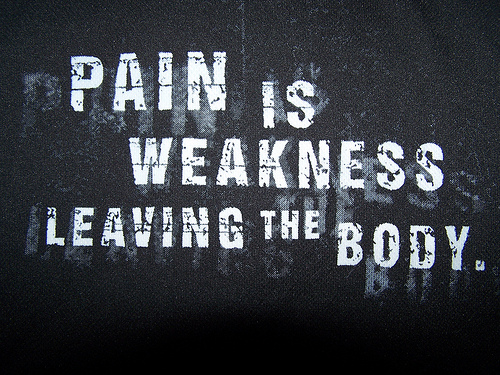
Pain hurts and can mean an injury that will sideline you for a long time.
Nope. Pain is an important signal from your body that something may be out of alignment, overused, or injured. As you become more active, pay attention to the soreness that indicates working at a new level (and can be relieved with some light activity, like stretching or walking), and sharp pains or tender spots that can indicate a problem that requires rest or treatment.

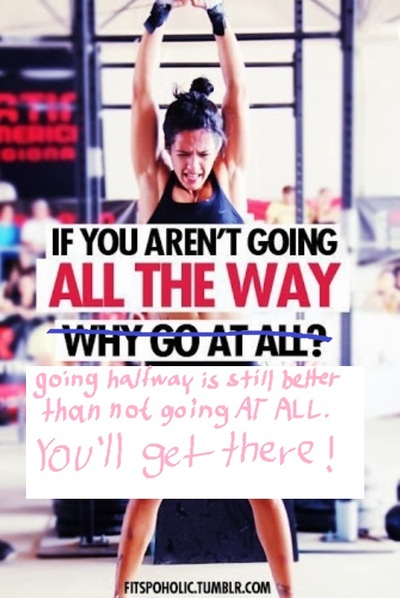
On Tumblr, fit-fabstroid has been posting revisions of fitspo imagery, and her edits are spot on.

If you aren't going all the way, going halfway is still better than not going at all - you'll get there!

Here are a few things I’ve had the pleasure of telling people when they are anxious about being able to make healthy changes to their food or exercise patterns:

1. Great journeys begin with a few steps. Don’t try to do everything all at once. If you need to make major changes both to the way you eat and how much exercise you get, choose 1 small thing from each column (like “I will drink 1 can less of soda every day” and “I will take the stairs when I get to work in the morning”). Spend a week or two settling into your new habits, and then think about adding to them. And if they aren’t working out the way you hoped, it’s OK to replace them with alternatives that point to the same goals. Just keep moving in the right direction.

2. Some stranger’s 2 cents probably isn’t worth even that. Joining a gym in January as part of your New Year’s Resolutions? You may get approached by a stranger telling you you’re doing something wrong, or just making an unpleasant remark about newbies. Maybe you are – there’s no harm in asking a staff member to go over how to use a machine or take a look at your form, and there are lots of variations out there for different training goals and physical limitations. Unfortunately, there are a lot of people out there who think they know a lot more than they do, and are willing to make strangers feel bad. Be open to the possibility that you can use some instructions, but don’t take some random’s word for exactly what that means.

3. Don’t get too focused on scale weight. The number of pounds (or kilograms) you weigh is a convenient measure that is cheap and simple, but it only tells part of the story. Your weight fluctuates a lot over the course of a single day – if you’re drinking enough fluids, that’s 4 lb of intake right there – so don’t get hung up on differences of a couple of pounds. There are lots of other non-scale victories in health and fitness: measurements, better blood sugar control, being able to do more (or do the same things faster) without getting winded. And of course, if you are doing strength training, you can lose a clothing size and stay at the same weight – or even gain a little at the same time.

That first push-up is a doozy.

4. Feel like you can’t even do the basics? You can work up to it. A military-style perfect push-up demands good core strength and body awareness to maintain good form, especially for lots of repetitions. And there are lots of “progressions” – modifications of difficult moves to help you get there – for almost any movement that’s challenging, from push-ups and pull-ups to yoga poses. Take a look at the right-hand column at Start Bodyweight for examples.

5. Try to identify things you can really enjoy. Hate running? Don’t run! There are plenty of alternatives, including walking, biking, swimming, rowing, jumping rope, yoga, video exercise programs, joining a sports team, martial arts, and old-school calisthenics, like sit-ups and push-ups. If you’ve been sedentary for a long time, almost any activity will give you benefits, as long as you are consistent.

6. There’s no law that says you have to have an explicit, long-term plan. You can start by taking the stairs more often, parking in the furthest spot in the lot, or adding a couple of short walks during your work day. Like more structure? Take a class, and see how it feels – maybe even try one new class a month for a while. This could be yoga or spinning or getting some friends together for an introduction to rock climbing. Another option is spending a session or two with a trainer at a gym. Just be honest about your goals (“I want to be able to open ANY JAR IN THE CUPBOARD” is a perfectly fine goal, as is “I just want a good start, and to find something I can stick with”), and feel free to tell the trainer to throttle back if you’re having a bad time. Exercise should be something you want to do, and you don’t have to feel sore for days to get a benefit.

7. Give yourself the gift of rest. It’s easy to get overcommitted, and for many of us that means not enough sleep on a regular basis. Eating better and exercising more are great, but sleep is just as important. Consider trying a sleep tracker to get some real information about how well (or not) you’re sleeping, or at least getting your eyes away from computer and TV screens well before bedtime (the light from the displays can make it harder to wind down).

Happy - Harrison at the beach

Exercise, healthful food, and adequate sleep should make our lives nicer. A better energy level, a better ability to move around our environment, often smoother moods – there are many day-to-day benefits of having healthy, sustainable patterns of eating, activity, and rest. If you’re making resolutions about food and exercise this year, let yourself focus on making life better – find activities you look forward to, more nutritious foods you enjoy, and explore little changes that are easy enough to do that you don’t even have to think twice about them.

Here is a nice list of short observations to help form perspective around health and fitness goals.

When a Woman Gets Negged

In the fitness community, there’s a lot of hand-wringing about women who shy away from challenging workouts, particularly lifting weights, because they don’t want to get “too big” or “bulky.” A typical formula for “addressing” this concern is to deny the possibility – to claim it’s “impossible,” relying on physiologic factors like testosterone level or, making the leap that such a description can only apply to competitive bodybuilders, to then “reassure” women that it takes years of work and careful supplementation to achieve that size.

Somewhere along the way, people in the fitness community have forgotten that women are bombarded with images about how important it is to be small, often in high-circulation print and broadcast media where more money is spent on advertising alone in a single quarter than the fitness industry generates in a full year. And for many women, those are not the most damaging messages. That distinction belongs to the personal remarks made by people in their lives.


Best part? In May she got a 20% raise at work!

Yes, Virginia, women do get told “You don’t want to do that – you will get big” or, as I was once told by a man pinching my biceps, “That’s not attractive.” I was lucky – it was pretty obvious to me that the guy was being a jerk, but women get these messages from people they love and who love them, too. When it happens it can be confusing and upsetting. There are a lot of factors at play, and suggestions like “use x snappy comeback” or “ignore and move on” are not sufficient responses to women’s concerns in this area.

Where does it come from?

Let’s stipulate that there is a lot of sexist societal baggage about acceptable size and strength for women, without worrying too much about what, exactly, that size is. I hope this is not controversial. I talked about some of the challenges women have faced in this area a few months ago, on the occasion of International Women’s Day.

We can also look at the covers of women’s magazines – no need to look inside. I hear people dismiss this media as if it’s foolish and irrelevant. There is some truth to that, depending on your demographic, but publishers aren’t in the charity business. These magazines survive and thrive because they have big, paying markets. Even not-terrible Women’s Health, which occasionally admits right on the cover that some women are more than 40 years old, has typically diminishing, critical cover messages:

These messages did not invent the problem, and indeed most media producers insist they are merely offering what women request. They are selling solutions for a need that many of us carry with us already: to be more attractive, more organized, healthier, happier. Media is under pressure to provide solutions rather than open-ended methods. So while most people can achieve those goals only with careful introspection, planning, incremental change, and frequent re-routing as they discover the right path, well, hey, that message won’t sell magazines – let alone fit on the cover.

“Don’t touch that – you’ll get hurt!”

When we are children, we receive warnings from our caregivers – be careful, it’s hot! Wear a helmet when you ride your bike! Don’t dive in shallow water! Social learning means we don’t have to make all the same mistakes that other people have made – we can learn from others (and go on to make new mistakes). This works for many reasons – kids do some of that stuff anyway, get hurt, and realize the warnings are meaningful, sure, but most of us, from early in childhood, want the good opinion of those who matter to us.

As we get older, the messages get more complex, bound more tightly in societal expectations. The landscape is complicated by competing sources of pressure and approval. If you do that, it will go on your permanent record. If you don’t do this, you won’t get into a good college. Girls get a big dose of Don’t do that – boys won’t like you. Or worse, Don’t do that – boys won’t respect you.

Unfortunately, the toothpaste is out of the tube: there’s plenty of boys out there that don’t respect you, and never will. And the more you do to become respectable – even admirable – the less they’ll like it. A friend of mine summed up the extreme of this attitude in “Douche V’s” Reasons Why Toronto is the Worst City in North America for Men, which includes a run-down of this character’s profile in the “Pickup Artist” community. If you’ve heard about these people and don’t want to follow the link, here’s the take-home message: this pickup artist finds Toronto an unwelcoming environment because it is difficult to “date up” – hard to get the attention of women who have better education and pay rates.

I bring these guys up not because they’re particularly important. Most of us will go our whole lives without ever being approached by someone like this. But they’ve codified a particular style of approaching strangers that they call “negging” – starting with a backhanded compliment or calling attention to a defect or failure, to get someone off balance and prime them for seeking approval. Pickup artists defend this practice as “banter,” and say everyone is having fun, but teasing, potentially insulting humor generally works best among people who already know each other well. Parodied by xkcd, negging attracts some pretty angry responses — it’s a bad-faith way to approach someone, and the fact that it can “work” (ie, lead ultimately to a one-night stand) can make it look predatory.

In the pickup artist community, one of the high-visibility members likes to take credit for inventing the “neg,” but this is absurd. We’ve all been negged over the course of our lives, often by family members, other kids at school, maybe even our teachers, sometimes by coworkers or friends. It’s a time-tested technique of bullies. And it is exactly what is happening when a stranger or a close friend or family member tells a woman anything along the lines of “why are you lifting weights? That’s not attractive.”

How do you respond to someone who is trying to diminish you?

A stranger approaches you as you do farmers walks. “They’re going to work your traps. Guys don’t like girls with traps.”

A family member, present when you happily report a personal best, says, “That is stupid and disgusting. Girls don’t LIFT 105, they WEIGH 105.”

A casual acquaintance at your gym says, “You’re doing great, just don’t go overboard … you don’t want to lose your femininity.”

These remarks represent expectations about what women are, and what women want, that may or may not have anything to do with what matters to you. They may represent an honest difference in opinion about what “femininity” looks like. They might just be a lightly veiled way of saying “I like you less than I used to.”

We tend to have one of three responses to such challenges. 1. We may disagree with them, and simply reject them – “Do I look like I care what you like?” 2. We may agree with them, but disagree with the recommended change in behavior – “I haven’t weighed 105 since I was 10 years old, and I don’t expect to see it again while I’m alive.” 3. We may agree with them and doubt our course of action – “Yes, I am making good progress, but am I risking something I value in the process?”

When a stranger says these things, it is easy to have Response 1, but they can be confusing when they come from a loved one. Family relationships don’t guarantee kindness — family members or close friends may be more likely to speak impulsively or unkindly, and then use the “trying to help” or “being honest” defense, because they know the connection gives their remarks power, even plausibility. Women can be vulnerable to this approach, because they are so often reminded throughout childhood that they should keep their voices down, avoid confrontation, “be good.”

What you say in these situations is less important than how you think about them for yourself. A nonplussed silence is a good option in public situations with strangers – there is no good reason to escalate an unpleasant interaction, and most people won’t persist when they get little response. With people you know, you must decide whether to seize a teachable moment, pick your battles (that is, maybe not this one), or just shut them down with a reply that is equally sharp. These options depend on the closeness and respect in the relationship.

Whatever path you choose, you must walk it with confidence, and this can be a daunting prospect, especially if you have recently adopted a new fitness regimen. You may be aware mostly of how much you have yet to learn, excited about where you are but perhaps unsure of your long- or even medium-term goals. That uncertainty should not deprive you of the ability to say, if only to yourself, “I’m making the decisions that make the most sense for me right now, and I’m looking forward to seeing where this plan takes me.” It’s an attitude that some of your detractors may be surprised to watch someone adopt, and it’s the best foundation for your belief that you can set new goals, and do the research, planning, and action to accomplish them.

Mostly I just get weirdness from people at the gym when I’m by myself – the completely unwanted and unnecessary spot, a woman passing by me lifting decided to share “you’re scary,” 20-something bro watching me finish my set needs to tell me “you’re stronger than me,” then lurk behind me for a whole ‘nother set…. My answer was “I weigh more than you and have been lifting longer than you, of course I’m stronger.” I noticed him watching me a couple more times that day. Poor guy just couldn’t seem to get his head around the fact that I existed. —Sharon Moss, strength-sports competitor

Moss sums it up so right, from the strange “public property” attitude so many women experience, even from other women, to the mild sense of threat from men who seem never to have contemplated that men’s and women’s abilities overlap. She enjoys the advantage of support from her close connections, but even those of us who don’t can benefit from this mindset of simple logic, applied within a diligent, consistent program. One of the great pleasures of advancing in any area is, after all, the confidence that comes with your growing ability and clearer vision for your goals.

Coco Chanel probably never touched a barbell, and she is famously quoted, “A girl should be two things: classy and fabulous.” She is also quoted, “A girl should be two things: who and what she wants.” A confident woman who can clean and press 200 lb can easily be all four. And in any case, maybe she’ll be so “big” that few will dare to say otherwise.