Tag Archives: san francisco

Raptors

Yesterday on my bike ride, I saw another person in a park gazing awe-struck at a raptor. This is the third time in a couple of weeks I’ve seen this. I’m in favor of anything that causes someone to stop and recognize the immediacy of nature, red in tooth and claw, but they seem to gaze with a reverence that is usually reserved for rarity. Raptors are not rare in San Francisco – several kinds of hawks are very successful throughout North America, except in the high arctic and in unbroken forest, and the Bay area is both a good place for raptors and right on a major migration route.

The red-tailed hawk, which is sighted thousands of times a year according to the Golden Gate Raptor Observatory, is considered a “least concern species.” In some ways, human development has benefited these and other hawks, by giving them poles to perch on and a mix of cleared and standing trees to provide hunting grounds and nesting areas. The Cooper’s hawk and the sharp-shinned hawk are the other most commonly sighted hawks here, thriving as they do with access to a mix of clear and wooded areas. The sharp-shinned hawk sticks to denser tree cover than some of the others, in part because this smaller hawk is sometimes preyed on by Cooper’s and other larger raptors. Ospreys – though not a common sight in San Francisco – are regularly present and also considered a least-concern species, in spite of some having been threatened by widespread use of insecticides such as DDT in the middle of the last century.

Around Lake Merced and in Golden Gate Park, raptors often keep an eye out for little rodents and other small mammals on the ground. Yesterday’s bird – a red-tailed hawk – was sitting on top of a streetlight, scanning around the road toward the golf course beside Lake Merced (perhaps thinking that if that runner kept staring, frozen, it would eat like a king that night). I’ve seen hawks successfully grab a meal in the park, too – once, memorably, mere feet away from a toddler that was excitedly babbling to his mother about the gopher that had just peeked out of its hole.

The Golden Gate Raptor Observatory conducts counting and banding activities every fall, educates the public about its activities, and reports its findings about raptor populations flying in the Bay area. Donors receive an annual newsletter and season sightings summary.
Alternative Transportation

Last dream of the night.

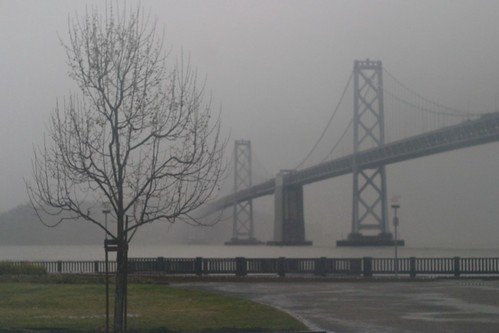
I was in a cross between Cape Town and SF – a tall hill sweeping down to the ocean, cut with deepwater ravines that had massive suspension bridges. I lived near the Golden Gate and worked near Fisherman’s Wharf. Over the hill was a shantytown of French-speaking natives, controlled by a small, white-haired woman who prided herself on her connection to white Anglo culture.

I went to the shantytown to visit a lab of sorts where small, low-impact motorized vehicles were being designed and built. Most of them were similar to recumbent bicycles but with 4 wheels. Some just looked like butterfly chairs on wheels. I tried one in the lab, and it was ridiculously fun.

The lab was adjacent to a small, secret hospital, illegal in this part of town. I discovered it when I was trapped in the lab and the end of the day, after all the whites had left the shantytown, and I was looking for a safe place to sleep. The hospital was not it; it housed growing numbers of poor locals who were coming down with a mysterious disease. The doctor believed the disease had originated in Ethiopia. The people I saw who were afflicted were losing digits one phalanx at a time, and had badly disfigured faces (essentially, lepers). The doctor was overwhelmed by the epidemic and had started limiting hospital space to those who could pay $15/day to stay there.

I left the lab and found myself in the lobby of the controller’s offices. She was being forced to cede her control, and she was screaming in French at anyone who would listen about all the terrible things that would happen when she was gone, including (where the hell did this come from?) British Airways losing its local hub.

This was not a good place to stay, so I went out in search of transportation over the hill and across a bridge to the part of town where I worked. I found a casual carpool car being driven by a small, sharp-featured man with black hair and blue eyes. There were 8 people in the carpool, and we all pushed toll money at him. He told me to keep mine, because he didn’t want to take me to work; he planned to take me somewhere else.

Rescue Corner, or How Cheap a Rationalization Can I Make for Getting an iPhone?

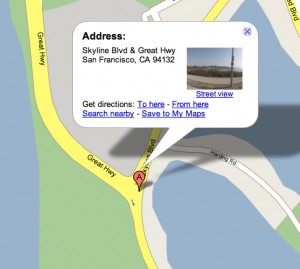
Great Highway and Skyline Boulevard

The traffic coming off Great Highway to Skyline is fast – the speed limit on that part of Skyline is 45 MPH. I’ve never seen an accident there, although I’ve been surprised not to have been a participant in one; cars cut the curve where they join very close, sometimes completely filling the shoulder, and as I see them more or less cut me off to do that, I wonder if they’d hold back just because there was a bicyclist on the shoulder.

It feels very dangerous to make that turn, but arguably it’s more dangerous to come back, where the shoulder is much narrower and often covered with plants that spill out from the embankment. (I don’t make the left onto Great Highway when I come back – I go up a little further, cross Skyline, and come back down to make a right.) The shoulder gets wider at the crest of the little hill at that intersection, and for some reason that area seems has been inviting some stops lately.

A few weeks ago, I heard a faint mewing as I crested the hill. A yowling, really, low and very distressed. There’s a big long island between the directions on Great Highway there, and I walked around in it for a couple of minutes before I located the cat it was coming from. (Hate cats? Pretend it was a dog – it won’t change the story.) She was a fat (but very cute) tortie who appeared to be scared out of her wits. She had a collar but no tags and a limp but no apparent acute distress over it.

I picked her up and held her for a little while, and she purred and nuzzled me. I carried her across the street to the only side (of the 3 options adjacent to the island) that was continuous with a residential area. She seemed unhappy when I put her down, but soon she trundled off in the direction of some houses, so I hope she was OK. (If you let your cats out and put tags with a phone number on them, someone like me will go ahead and call you up in a situation like this.)

Yesterday as I came up that little hill, I saw three people, all with their bikes upside down and all looking at the back wheel of one of them. They wanted to know if I had pliers, which I didn’t, but because the bike in distress had a broken quick-release mechanism, what they really needed was a bike shop. I am not a bike shop, but I have Google in my pocket (they only had more conventional cell phones), so although it took several minutes of somewhat arduous surfing, I was able to discover that the closest bike shop I knew of has since closed and to direct them to the next closest shop.

Just a few months ago, I’d have said there’s not much to say about this point on my ride – it’s usually unpopulated and quickly passed through. Now I wonder if I’ve been put on some kind of notice. Should I pack extra tools, kibble, and water when I’m riding through there? Should I get a phone with faster Internet connection?

Everything for a reason

I live on a rocky hill in San Francisco, among the stablest parts of the city, and sufficiently elevated that even my belief in global warming leaves me free of immediate fear.

There have been no noticeable earthquakes since I moved here, the last one in 1989, serious certainly but not part of my memory. My high-school sweetheart was visiting when it happened, walking down a street in San Francisco – not visiting me but visiting the neighborhood where I live now, a block away from the corner where he was staying.

And that summer he was walking down the street in San Francisco, finding it pleasant and friendly and walkable, a sort of cheerful, hilly Manhattan in its square breezy way, and the ground shook, and near him elevated freeways collapsed, and over the hill from him a whole neighborhood shuddered on suddenly liquified landfilled ground, and its gas mains broke, and it burst into flames. He hasn’t been back.

In 1989, I was back in Seattle, living in the Scandinavian neighborhood over the hill from the University district. It was quiet, a retirement home was right across the street from me, and pious, with a Lutheran church every few blocks. How strange and unimaginable that a few square miles of single family homes with rare apartment buildings and complexes could support so many churches, but it was easy to see how once one moved there, it was hard to move away. The houses are so pretty, red and black brick with inlaid patterns and pretty peaked roofs, and manicured lawns with irises, daffodils, alyssum, and dianthus smiling at the sidewalks.

I had recently moved back from California, where I had been accepted to both the state schools I applied to, Berkeley and Santa Cruz, and I had decided that I didn’t wish to live in the Bay Area, and so I would go to Santa Cruz. And live in a house with happy, potsmoking, middle-class liberal kids and plan my senior project with my house advisor (draft proposal: industrial design as reflected in Warner Brothers cartoons of the 1960s). And as soon as I could, I’d move downtown, to a tiny apartment by the beach, and it wouldn’t be much, but it would be mine, and I’d need to be on my own again after sharing a room and a kitchen, and a phone.

Suddenly a month or so before the term began, I couldn’t stay, and I packed and moved back to Seattle, abruptly, in the space of a few days, just as I’d moved to California a few months before. It was December, and 4 days before Christmas. When I got home, my boyfriend broke up with me.

But I was back in my home state, in my home town, where my mother was a professor at the local state school, and my friends knew people who were looking to sublet apartments, and soon I was sitting in “distribution” classes, thinking about what to major in, settled into my little apartment in the Scandinavian neighborhood, barely squeaking by in my macroeconomics class with a passing grade, and getting a completely perfect score in Medieval English Literature survey.

And in 1989, Loma Prieta struck. It damaged property extensively in San Francisco – some of the infrastructural damage it did has only been repaired in the last few years, and some of the buildings it left condemned still stand, empty, boarded up, and signed with warnings. But San Francisco was not the epicenter, not even close. The epicenter was 75 miles away in Santa Cruz, downtown, right at the Boardwalk, right near the beach, right beneath the tiny little houses where I’d just have made my home, after my second year in the dorms up the hill at UC.