Flickr is having load problems – which means that just about all the images on my blog are inaccessible. They hope to have things smoothed out soon. I hope they do, too!
Update: Yay! They did!

Flickr is having load problems – which means that just about all the images on my blog are inaccessible. They hope to have things smoothed out soon. I hope they do, too!
Update: Yay! They did!
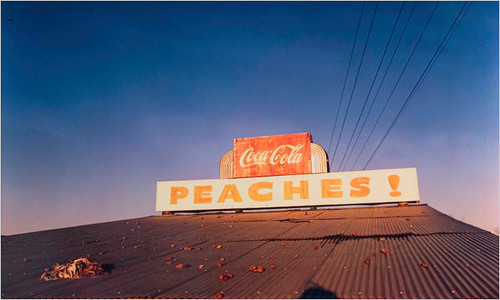
The other day I overheard someone quoting “really like your peaches, wanna shake your tree,” and it’s been going through my head ever since. Really just because it’s funny. Then I saw this article in the New York Times about William Eggleston’s work, illustrated with the photo above, which now looks even more wonderful to me than usual.
Eggleston took pictures of “nothing” and “nobodies” in color when art photography was very serious and very monochrome. He also did this in the Mississippi delta. Now that the country is engaging in an extra helping of hand-wringing over regional divisions and, here in California, a new crisis of civil-rights, his intimate, loving photography of a deep South in transition is helpful and humanizing.
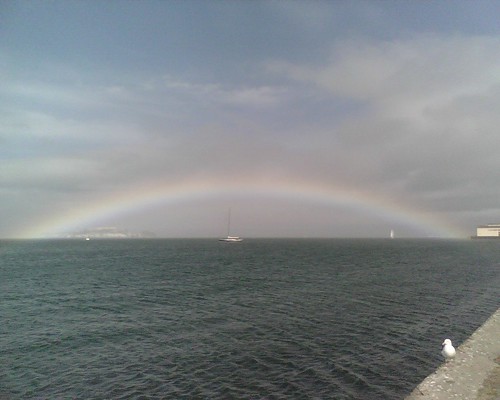
I’ve been taking a lot of bike rides at lunchtime this year. I nip out to Fort Point and back – about 10 miles round trip. Sometimes I bring a camera, because there are lots of birds on that route, but sometimes all I have is my phone – which almost did the job on this partly cloudy, drizzly day, when a rainbow stretched from Alcatraz to Fort Mason as I rode back to the office.
Congratulations to Senator – President-elect – Obama!
I am at an old boyfriend’s parents’ place. They’ve died, and I’ve inherited everything. He and I are no longer speaking – we were never all that close, and we don’t have anything to say. As I walk through the house, I can’t think why I’ve inherited.
The house is very beautiful, with simple lines and lots of glass walls. It is at the top of a steep hill that is thick with complicated rabbit warrens, all whitewashed stone and clay and glass. None of the houses have any surfaces that are more than one floor up from the earth, but because the hill is so steep and the houses so thickly built, there is a sense of a massive, towering edifice, with floors connected by narrow alleys and stairways so steep they are more like ladders.
My mother comes to visit me, and we are at the bottom of the hill when there is a flood advisory. We rush up the hill, and we talk about the house, which she hasn’t seen yet. When we get to it, my old boyfriend is inside. He has made a cup of tea and is watching the floodwaters rise in the distance below. We do not speak.
My mother and I start going through the rooms of the house, culling out things that don’t quite match with most of the contents of the various rooms. I am packing things to give to my old boyfriend.
When I look out the window again, it’s night, and I look through the glass roof into the sky. It is dense with stars, as in a developing country that cannot afford to have light pollution. You can clearly see the outline of the lower part of the African continent, with a completely thawed Antarctica balanced on its cape, curved up into the sky like an enormous breaking wave.
Several years ago, I found a portfolio of work by Bri Hermanson and fell in love with her viscerally effective work. Political, social, literary, epic, she’s used her woodcut-like technique and wonderful sense of muted, blocky color to tackle the World Trade Center bombing, the phenomenon of McDonald’s, and, recently a very quirky Tarot deck. (Go look right now. I’ll wait.) I just happened across this tonight, in an old blog entry of hers:

She made it for the New Yorker cover contest earlier this year, and I, well, I wish I had seen it then.
The city calls for green. The green calls for civilization.
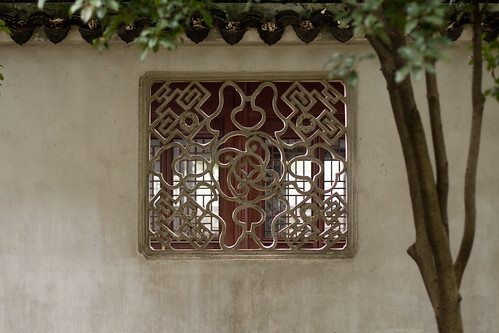
I have been pretty tired this week, getting back to work and finishing processing my pictures, so I’m really only halfway through the last batch. My last full day in China involved a stop in SuZhou, a beautiful little town with at least 9 formal gardens. We spent a couple of hours in the largest one, UNESCO World Heritage Site the Humble Administrator’s Garden (Zhuozheng Yuan) [Wikipedia] [my pictures at Flickr]. I am in love with these dense mixes of nature and architectural detail. More in the next few days.
China has some ADORABLE trash cans.
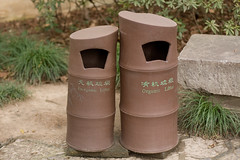
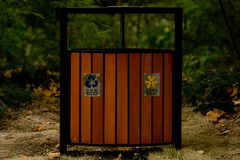
I have one quibble with them, though. They have English translations that aren’t so helpful. The pair above on the right say “Recycled” and “Organism.” On the left, “Organic Litter” and “Inorganic Litter.” This pair below was most helpfully labeled: “Recyclable” and “Unrecyclable.”
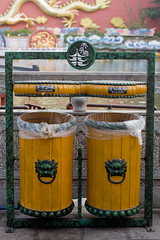
Also, this last pair could swing back and forth on the pins you see about midway down, which was pretty fun to see!
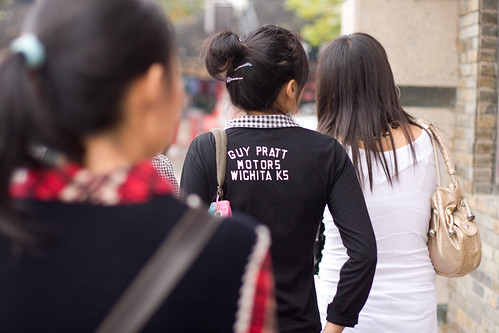
This is about 100 miles from my other such sighting, and a quick check on the Internet says a similar shirt (larger lettering) has been sighted in Korea. Is it some profoundly obscure reference to the bassist? Or just another one of Asia’s talismanic uses of English text?
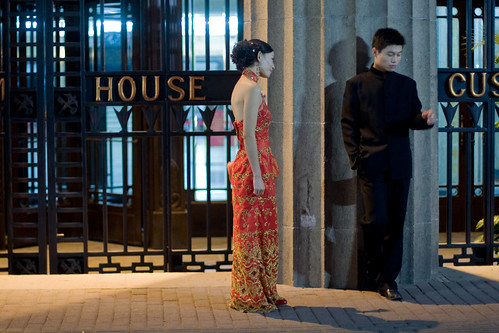
We took a little excursion to Shanghai, holed up in a pleasant hotel, and had a slow couple of days. We stayed in an area that has mostly colonial architecture, across the river from the oddly org-chem-model-like Oriental Pearl Tower.