Category Archives: Fitness

On International Women’s Day

It’s been celebrated in a Google doodle, and has triggered articles on everything from how fantastic women are to “why is this still a problem when we supposedly know how fantastic women are?” It’s been observed for over 100 years, with roots in the workers movements of the early 20th century.

This year, International Women’s Day arrives as I’ve been reading about the development of physical culture in the US, particularly how women were addressed and presented. A friend recommended the wonderful Venus with Biceps, a book discussed at length by Maria Popova at Brain Pickings.

The Braselly Sisters, above, were a pair of strongwomen who specialized in graceful and artistic strength stunts. They were sisters of the even more famous Katie Sandwina. But physical culture and athletics for women were shaped by far more than circus acts.

Helen Wills (1905-1998) achieved international fame as an athlete with a phenomenal string of tennis victories, including 2 Olympic golds, 7 US Open grand slams, and a career streak of 158 wins.
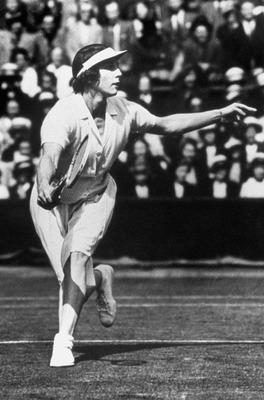
An excellent student, dedicated athlete, and active writer and painter, Wills was described by others as reticent, shy, and awkward. She had a style of play described by competitor Helen Jacobs as “a machine… with implacable concentration and undeniable skill” but (and?) by Charlie Chaplin as the most beautiful thing he had ever seen. Her introverted and detached style cost her popularity during her career, and can hardly help but fascinate in a society that is grappling with what it means to be neurotypical. In her own words, “I had one thought and that was to put the ball across the net. I was simply myself, too deeply concentrated on the game for any extraneous thought.”

Kathrine Switzer made athletic history the year I was born, when she ran in the Boston Marathon. Other women had joined the race, but Switzer registered (as KV Switzer) and ran with a bib. What happened next is a startling demonstration of terrible sportsmanship.

Race official Jock Semple attacked Switzer on the course:

A big man, a huge man, with bared teeth was set to pounce, and before I could react he grabbed my shoulder and flung me back, screaming, “Get the hell out of my race and give me those numbers!” Then he swiped down my front, trying to rip off my bib number, just as I leapt backward from him.

Her boyfriend intervened (knocking Semple to the ground), and she completed the race, in an era when women were still being told they could damage their reproductive organs by running. I think the thing that disappoints me most about this incident is how appallingly recent it is.

Women running are commonplace now, all over parks and treadmills, occasionally mocked by some in the fitness industry for dogged devotion to high mileage and charity events. Almost every Olympic event now includes women, not just in track and field but into wrestling and boxing and beyond. Women still get told some pretty crazy things about one of the simplest and most basic athletic endeavors, though: weightlifting.

In Venus with Biceps, writer David Chapman notes that even when women were recommended to take up resistance training with free weights, they were started with light, wooden dumbbells – in spite of the fact that at home they were lifting laundry baskets and children that weighed much more. More than a century later, women are still getting the same messages, and hearing scare stories on par with the claim that running makes your uterus fall out. Weightlifting seems to elicit the purest fear about women: that they will “become” men.

Who could ask for a more concise counteragument than the fantastic Abbye “Pudgy” Stockton?

Stockton, who had been heavy as a teenager, took up weight training because her boyfriend brought her some equipment, and she joined him in the heyday of Muscle Beach, where they performed elegant and remarkable acrobatic and gymnastic feats together. A columnist for Strength & Health magazine, Stockton was also a popular media subject, appearing in pictorials and on covers of dozens of magazines, featured alone and with other bodybuilders. She helped to organize the first sanctioned weightlifting competitions for women, and was inducted into the International Federation of BodyBuilding & Fitness Hall of Fame.

If I have just one wish for us as women, it’s to be treated with respect as we pursue what appeals to us most. Humans are social animals, and everyone gets prescriptive messages about some things, but women bear a greater – and more patronizing – burden in this regard. Maybe on a future International Women’s Day, we could enjoy 24 hours during which the presentation of a photograph of a woman actually doing something – like powerlifting or answering questions put to her as Secretary of State – was not immediately greeted by a man judging her sex appeal (probably negatively). A girl can dream.

What It Means to Be Thin

I have always been a fairly capable athlete, but my weight has bounced around a little over the years, particularly as my allergies and asthma have worsened. A few years ago, I had my treatment regimen reorganized, and while it took some time for everything to work smoothly, it was particularly nice to be able to step up my physical activity again.

In 2011, as winter approached, I decided I’d like to have a home option for a good workout on days I didn’t feel like riding my bike, and I got a rowing machine. That’s when I realized how much difference the better medical management made. Within 6 months, my body fat percentage, already well within the healthy range, dropped by 25%. I looked different. Lean.

Anyone who has lost a lot of weight has encountered this: people remark on it, and it’s usually positive, if clumsy, but all kinds of loaded terms come out. Skinny. Thin. Sometimes people we are close to have a negative response when we make a big change in exercise pattern or appearance, and the comments are frankly unkind. They may make fun of choosing fruit instead of a cookie, or warn against losing any more weight.

When my body fat percentage dropped, I only lost a few pounds. I replaced about 70% of the fat weight with lean body mass, tested before and after by BOD POD. (I had suspected my body would change, and I was interested to see how.) But I still got remarks like “too thin,” and expressions of concern. People with a chronic illness can become very lean, after all, even if there are no body-image issues at play, and I had been having health problems. Assuming that those remarks came from a place of caring, I tried to explain that my athletic performance was increasing in pretty much every way, but the only people who really engage with that line of reasoning are already doing the same things and, if anything, bring it up more likely to see if they can adopt your approach.

Over the winter holiday week, my mother and I were talking about some frustrations I’d experienced, and how I was feeling better overall. She made a lot of “thin” remarks last year, and it was a little frustrating, especially because I felt it was clear that my performance was improving. And she said, “I just remember you saying years ago that you felt that being thin equaled being depressed.”

She’s absolutely right, and I’m surprised I didn’t think of it. I am deeply sorry she had even a moment’s concern over why my body was changing so much, especially now that I have also realized that being heavier was part of the same problem. What matters to me now is keeping it all in balance: activity, food, sleep, well-being. Plus giving a little more thought to what people are trying to say when they comment on the surface.

Beyond Resolutions – to Action

Tis the season for resolutions, for big, sweeping goals worthy of a year-long timeline. And that is part of the problem. Few people have ever planned a year-long project, even if they have made resolutions all their lives. Another problem is that people often make resolutions that are about habits. Many of us can just gut it out if we have to get a specific thing done in a particular time frame, but creating habits – or worse, breaking them – is about more than just determination.

Many people frame habit-focused resolutions as if they are single-destination goals. Weight loss is the perfect example. Losing weight may be treated as a black box (“I will lose 30 pounds”), without much thought to why or how. Anyone who does go to the gym sees this type of Resolution Maker for a few weeks every January, by which point there’s a crisis at home or work, or they become injured, or worse they find their weight has plateaued or even risen, and they lose momentum and stop showing up.

And then there is the foundational problem: framing a goal without really exploring the motivation. Do I lose 30 pounds because I want to fit into those pants I love? Because my doctor told me my cholesterol is too high? Or because I believe that at my height I should have a specific weight? Sometimes we know the “real reason” and paper it over with one that is easier to speak aloud, which makes it even harder to reach our goals.

This is exactly the battle that knowing is half of. Some goals are worth examining and discarding – I’d place “I should weigh a specific number of pounds” in that category, not least because your weight can fluctuate by a surprisingly large amount through normal activity during the day. Others are worth understanding so that you can see your success – taking measurements on your path to those pants, or doing follow-up lab tests.

And then there’s the challenging part: devising a plan to reach the goal. Most of us have learned that you should break up big tasks into smaller, manageable parts, but that’s not always as easy as it seems, and breaking the big task up is just another item on the to-do list. Maybe tomorrow. Rather than wait for motivation to strike, maybe it’s time to start even smaller than that.

BJ Fogg runs the Persuasive Technology lab at Stanford University. He’s been pioneering a habit-changing methodology that he calls Tiny Habits. The basic point is that you can be highly motivated but still not change your behavior, because it’s hard. It may not even be that big a deal, but it’s big enough, and that’s OK.

With Tiny Habits, he encourages people to choose very small actions that they’d like to make habitual, things that can be accomplished in less than 30 seconds, and simply do them for 5 days. He also asks you to anchor your new habit to something you already do. “When I get up in the morning, I’ll stretch for 30 seconds.” He has an accountability option at his site, too – join, and for 5 days, you’ll receive a daily email simply asking whether you performed your tiny habits.

It takes longer than 5 days to fully embrace a new habit, especially if it’s very new, but 5 days is long enough to get a gut check on what’s working and what isn’t. Fogg invites you to think about what worked and what didn’t, and to revise accordingly.

This is what makes advice like “take the stairs instead of the elevator” or “park at the furthest spot in the parking lot” work well for people. But Fogg makes it even easier. His small approach reminds us that it’s not absolute – we choose a consistent, daily anchor to help cue us to practice the new habit, but that may be one opportunity of several to take a specific action. So we start by taking the stairs only when we get to the office in the morning. And he reminds us that it’s OK to change course, which opens the door not only to finding a better way but to expanding our effort or commitment as we become able to do so.

Have you used Tiny Habits, or another “start small” approach to make a change? How did it go?

Close to Nature

I started swimming a couple of months ago. I have always been a person who could get around in the water, but I had never learned any proper swimming strokes. I was inefficient.

I had tried to take classes but without much success. I don’t really enjoy group activities, and adult swim classes tend to be pitched wrong for me. I am a pretty good athlete in general, and comfortable in the water.

I finally signed up for a series of one-on-one sessions with a coach, and it’s something I should have done years ago. Within a week or so, I was swimming regularly at Aquatic Park, an outdoor swim area with an almost 300-meter buoy line. I go a few times a week now, and I always have a good time.

Mostly. Lately the park has attracted a couple of sea lions. For several weeks, it seemed like this was limited to somewhat shy visits from a younger male, who mostly hung around just outside the swimming area. He seemed hesitant, maybe even safe.

But people have been bitten at this beach before, although rarely. The consensus on the “rogue sea lion” in 2006 was that he was somehow ill.

Well, OK, this isn't what happened, but this is about how I felt about it.

That doesn’t make me feel any better about the large, adult male sea lion that visited Aquatic Park yesterday. I saw him as I sat on the beach, about to get out of water, and I wonder how long he’d been gliding around as I was doing my 7 laps. He certainly seemed right at home, swimming well within the swimmers area, past little groups of swimmers that were still in the water, eyeing us all casually.

Here’s hoping he’s healthy and has satisfied his curiosity, and won’t be back.

The Nike+ World Turns

The FuelBand activity is over, and the devices are returned. I asked a Nike executive at the conference about what happens to the other Nike fitness properties, now that it looks like Nike is recomposing the “Fuel” concept from calories to this weighted score. He said, oh, it will take months to reorganize that stuff. I said I was worried, because the FuelBand and site do so much less than I already getting from the Nike tracking I was using, and he said he wasn’t really involved with that. Fair enough.

Today the tracking product that drew me into the Nike+ ecology announced that their site will be down for months while they get rolled into the new thing.

The tracking product I’ve shifted to is still alive and well, prominently linked directly from the new hotness as a menu item, and so, one hopes, unlikely to disappear anytime soon. It is a very different product from FuelBand, and fits well into a mix that serves all activity levels. Nike+ has turned into a confusing crowd of sites and products, and simplification is good, but the timing woke me up abruptly this morning.

I am glad I’m not on the support queue that will take calls today from people who spent the last couple of weeks or months getting hooked on the website companion to a different piece of hardware they already bought. The email tells them that their data will still be there at that indeterminate point in the future, but these products are about habits and regular reinforcement. Months from now might as well be the heat death of the universe. I remember how entertained I was by rewards displays when I first found those sites, and I know I’d be pretty frustrated if I were waking up this morning to learn that I’d never get a chance to see all the levels.

Trying Out the Nike+ FuelBand

I am using the Nike+ FuelBand this week as part of an activity for a conference I’m attending. I like gadgets and already wear a pedometer, and I’ve been curious about the FuelBand. It’s been an interesting few days.

Nike hints that the FuelBand is something special, with lots of different ways to evaluate your activity, but it’s mainly a wrist-based pedometer. As a consequence, it can’t always capture your steps and records “steps” for rhythmic arm motions. (I have worn it overnight a few times and “learned” that I took a couple of dozen steps in my sleep, which I definitely didn’t, although I do move around a bit.)

Nonwalking activities are represented as “steps,” generally yielding low activity estimates. Rowing on a machine or riding a bicycle shows strokes as steps, and it acknowledges stroke rate – the bike is more ‘caloriffic’ than the rowing machine – but can’t understand resistance. (Nike claims its logic is more than just pedometry, but I have kept wearing a pedometer, too, and it looks like pedometry to me.) Of course, those activities are better measured with other devices, but it puts the active user in the position of having having irrelevant information when thinking about their overall activity for the day.

The display is simple and narrow, with a few measures (steps, calories, and “Nike Fuel” – a weighted calculation that seeks to provide a common measurement unit across individuals and activities). It also serves as a watch. The display includes a line of tiny dots that light up as you progress toward your goal for the day, with the first dots in red, the middle dots in yellow, and the final dots in green. The device itself is simple and attractive, and sits unobtrusively on the wrist. I placed it on my ankle for bike rides. It is too small to clasp over my ankle but the shape is sufficient to hold it there as a cuff-style bracelet.

FuelBand offers no way to designate a start and stop for a specific activity, has no stopwatch, and displays only a few built-in measures. The web interface and iPhone app show an hour-by-hour breakout of your activity level on a graph, but they don’t show start and stop times or splits. In general, though, the app and web interface are pleasant to use, with stylish visualizations and cute reward sequences for meeting goals. You can also sync to your iOS device anytime throughout the day, which makes the device more engaging and interactive than a simple pedometer.

On setup, FuelBand invites you to set a daily goal, but changing it only takes effect the following day. I first selected 3000 points as a goal (defined by the system as an active day). I swamped that on a normal work day and selected 5000 points the next day, exceeding that as well, but when I decided to have a slow day, I was out of luck; I’m now wearing a device that is chiding me with little red dots for being lazy all day just because I didn’t plan my laziness last night. This merely annoyed me as a motivated, athletic person, but I wonder if it would make a less combative person take the FuelBand off and put it in a drawer.* Battery life is rated at about 4 days, but I find the battery is down to around 20% at the end of single day. In short, I’m getting lots of cues that this device was definitely not designed with me in mind.

I’m glad I had the opportunity to test the FuelBand. Nike has promoted it heavily with its Nike aesthetic, which is much higher energy than the apparent target audience, and the promotion definitely activated my covet drive. FuelBand is a good choice for someone who is already using iOS (the only OS the app supports for now), wants a set-it-and-forget-it tracking device, and just wants some reinforcement for moving around more during the day. It’s particularly bad news for the Jawbone UP, which suffers from much less name recognition combined with a recent episode of major manufacturing trouble. If you’re an active athlete, you’re better off sticking with your sport-specific devices. But it’s a nice gateway device for people looking to get more movement into their daily lives, just as walking is a good gateway activity.

*There are lot of good reasons to decide on the fly to have a slow day – illness, injury, or a dramatic change in plan, for example. The user can add a brief note and choose a mood icon in the web interface, but the purpose of the red dots on the progress display is to remind you to shake a leg. If the developers are already counting on the user to be susceptible to being nudged, they can expect the user to feel criticized, too – and not best pleased if it feels unfair.

Thoughts about Introducing Minimalist Running

Running Times shares this video showing some flexibility tests you can do if you are wondering whether minimalist running is for you.

Some people find this approach fussy and overly complex, but I think it’s attempting to be mindful of the reality that there is a very wide range of starting points. For most people it’s not enough to say, “Try it out, and if it doesn’t work for you, don’t do it.” This is a hard problem. You have a few minutes – how do you account for different strides, levels of experience, levels of confidence, medical history, terrain interests?

Bonus: It does a nice job of saying “this is a long-valued approach” by showing some vintage flats, designed for the Olympics, from before the ascendancy of today’s heavy-soled, built-up-heel “traditional” running shoe.