Category Archives: Fitness

Do fitness trackers actually work?

My guilty pleasure is Quora, which I dip into if a question intrigues me. Sometimes I “archive” the more interesting topics here.

Do Wearable fitness trackers actually work?

Yes and no. Complex fitness trackers, like Garmin watches, are excellent for people who already want to exercise a lot and use metrics to meet performance and recovery goals. For those people, the value of wearables is unquestionable – it’s just a question of which model gives them the right mix of features, and they’ll come to that question with lots of knowledge and specific preferences.

Simple fitness wearables, especially those that are designed to blend in better with non-exercise clothing, work on the principle that if you give people information, they will make better choices. In general, that doesn’t hold across the board for people (look at the range of ideas out there about vaccination, for example), but at least in the case of wearables, you are usually talking about people who are already interested enough to buy one.

When people ask whether fitness wearables work, they usually mean “do people who wear fitness trackers exercise more?” Any stimulus for behavior change has to have 3 elements: the person has to know what to do, it has to be achievable, and the stimulus has to be salient. That’s different from “you have to really want to” – it means you have to notice it and respond to it in a predictable way.

The design of a fitness tracker can make or break the response even of a person who wants to use a fitness tracker. I tested a Nike Fuel Band almost 10 years ago. In many ways it was a nice device, although I wasn’t really the ideal user for it. It had one “feature,” though, that made me hate it. You set an activity goal and throughout the day, as you racked up more activity, a line of colored dots would change from red to green. So far, so good, right? But any changes to the activity goal only took effect the following day. While I was testing it, I had an injury early one day, and then was followed around by this red line all day even though it would have been absurd for me to pursue the goal. I was actually amazed by how angry it made me, and I’m a confident, knowledgeable exerciser who was just testing the thing for a week. (I have a dim memory of really enjoying some of the other ways it presented information, but at this remove, all I can remember clearly is that infuriating red line!)

I believe the rationale for limitations like that is “accountability” – to reduce the temptation, if a goal is not being met, to simply make the goal easier. OK but we’re talking about a goal that is supposed to serve the individual, not a test that’s being graded by some outside authority figure. Accountability is going to look different for different people, and the concept of a rigid daily goal with a constantly visible indicator is problematic. Among other things, it “punishes” you for having a rest day. You should have goals but you should also have a clear and healthful balance between “getting the check mark” and putting your foot down (or, perhaps, feet up) when you need to.

In principle, pedometer-based trackers are great for people who want to move more because they offer a clear indicator of how much movement is being done. This can be disheartening but the key as a beginner is to choose an attainable initial goal, even if it seems easy right away. I always urge people to think carefully about what they want out of a tracker to be sure they are not going to resent what it tracks or how it presents information. This can be a long conversation that ultimately touches on things that are unknowable or not much fun to talk about, especially for someone who is struggling to be more active and whose strongest associations with exercise are some crappy middle-school gym class experience. Fortunately, there are quite a few inexpensive options out there to let a person dip their toe in while they learn what will end up being most important – and most helpful.

So do fitness wearables work? Yes and no. Can they work? Definitely.
My answer on Quora

Perceived Effort in Rowing vs Running

My guilty pleasure is Quora, which I dip into if a question intrigues me. Sometimes I “archive” the more interesting topics here.

Why don’t I feel as exerted exercising on a rowing machine as I do with jogging, even when the rowing machine is on highest resistance?

I am not much of a runner but I erg a half-million meters or more per year. Running has always struck me as much more difficult just because of the impact factor (and as a consequence, I do it less). Proficiency, familiarity, experience, and some of the variations in people’s bodies can all account for different perceptions of exertion.

My first high-volume exercise experience, in my teens, was lots of cycling, and I also started doing some barbell training before I started using the erg. I think both of those probably helped, to some extent, with the technique and rhythm/control aspects of the erg. I had to work a lot harder to learn, practice, and become proficient in technique for a smoother, more efficient running stride. So I too find rowing “easier” than running, although I can certainly get a good workout with either one. Someone who grew up loving cross-country running and first used an erg much later might have the opposite experience.

As others have said, if the machine you are using is on “the highest resistance,” and assuming it’s a rowing ergometer, you are probably putting unnecessary pressure on your back and breaking form. There are a few technologies out there, though, and I only have experience with how the Concept2 machines work. For those, though, you should adjust according to the drag factor readout on the performance monitor, and choose a drag factor that suits your age class, weight class, and expertise – somewhere in the range of 100 to 135 for most people. The highest drag factors should be reserved for very short tests.

Concept2 ergometers can produce the desired drag factor at very different damper settings depending on how clean the flywheel assembly is, how old the machine is, and on the environmental conditions (pressure, humidity). With an unfamiliar machine, you should always check the drag factor before you settle on a damper setting.

At a hotel, I once used a very sad, lonely Concept2 erg that could only eke out a drag factor of about 100. A new machine (at sea level) ranges from <90 at the lowest damper setting to >200 at the highest. If you can’t get a normal (up to 140) drag factor out of a Concept2 at a gym, you should probably tell the staff to get someone in to give it some care (or consider replacing it).

Is 10,000 steps a day good for you?

My guilty pleasure is Quora, which I dip into if a question intrigues me. Sometimes I “archive” the more interesting topics here.

Is reaching a daily target of 10,000 steps good for you health-wise?

Sure – one of the largest studies to look at this question (using accelerometry-monitored activity) just added some evidence to this pile. Accelerometer measured physical activity and the incidence of cardiovascular disease: Evidence from the UK Biobank cohort study

The number 10,000, however, is completely artificial, as is the idea that it should be steps. Almost any amount of daily activity improves health outcomes – not just walking, not just over an hour a day. I have read that 10,000 became popular because it was part of the marketing for a pedometer in the Japanese market (where the number 10,000 is sort of a visual pun in that context). What 10,000 Steps Will Really Get You

It is common to see people try to tear down this number, or insist that it is an inadequate guideline because people should also be doing resistance exercise, or claim the “real” number is higher or lower, but it’s important to look at what question they think they’re answering when they say that.

Studies that try to address this have to choose an outcome to test – in the case of the new accelerometer-based study, that outcome was association with heart disease, and others have simply used all-cause mortality. It’s very unlikely that any of these study designs is directly measuring the “causal” element for those outcomes. For example, if runners are more likely to be hit by a car, does that mean running is dangerous? In the PLOS-published study above, did the exercise prevent heart disease, or were people who were less likely to get heart disease also more likely to enjoy exercise?

But the outcomes they test might not be the most relevant for recommending exercise in general, which can help regulate moods and sleep. No matter what you’re going to die of, you might as well be happier and better rested, right? Also, fairly modest amounts of physical ability are associated with living independently (in the sense of not needing direct assistance for activity of daily living) for longer. Prevention in Older Adults – Fundamentals – Merck Manuals Consumer Version Staying active throughout life is the best way to address this, because older adults who have already lost muscle mass have a particularly hard time adding exercise into their lives.

It is possible that there is truly an ideal, optimal exercise plan that would maximize the potential benefit of exercise in every person who followed it, but it’s more likely that individuals can benefit more than enough from any number of activities as long as they are practiced regularly, ideally daily. In meantime, the good news is that even though many studies show “more is better,” benefits are usually visible with modest amounts, too.

My answer at Quora

Coping with Cat Allergy

My guilty pleasure is Quora, which I dip into if a question intrigues me. Sometimes I “archive” the more interesting topics here.

I am fairly allergic to cats. My girlfriend has a cat, and whenever I go over, I feel miserable. How can I avoid this problem without getting some sort of medical therapy like shots every week?

I am a lifelong cat owner who developed a cat allergy in my late 20s. I have chosen to keep having cats, because I had my first cat at age 4, and I just love having a cat at home.

At some point, you may elect to end this relationship because the cat makes life too uncomfortable for you. That is fair. Asking her to rehome the cat is not fair to her (or her cat). You should make sure you have some antihistamines available. (Diphenhydramine is the fastest, and drowsy-making; chlorpheniramine works well, but is too much like a sledgehammer for me! In my experience, the best nondrowsy antihistamine is fexofenadine, but my mom actually finds relief from loratadine – in any case, try around.) Note, this is just for your comfort while you figure out what the best long-term plan is for you.

I use a daily immune suppressant + antihistamines at night. I occasionally use an inhaler. I have never wanted to do shots; that form of therapy is lengthy and very inconvenient, and the success rate is not that great. Cats are not my only allergy, which has been a factor in my decision. I react less to my own cat than to stranger’s cats, which I take to be evidence that sensitivity drops with time. (When I was first diagnosed, I was almost unable to work for about a month; now I occasionally benefit from resting for a sick day or two.)

Others have suggested cat wipes. You can also wipe down surfaces with allergen-denaturing stuff, use air cleaners, and use monthly clean-water soaks for the cat. All of these have the effect of clearing away active allergen. I found all that environmental stuff very helpful when I was first diagnosed, but now (about 20 years on), just having a HEPA filter in the HVAC system at home keeps me in reasonably good shape, with the drug therapy.

In your girlfriend’s position, I would be sympathetic and want to help, but I would have limits. I would be happy to do some environmental work, and I would be very grateful if you offered to help. (I have a soft spot for the single-room air cleaners designed for kids – I have one shaped like a penguin, and it always makes me smile.) Personally, I would never consider keeping my cats off the bed, and if she is like me, that may be a deal breaker, but on the other hand, environmental changes and a little drug therapy might work well, depending on the seriousness of your reaction and the possibility that exposure alone will help desensitize you.

My answer on Quora

Oprah, Weight Watchers, and “Impossible”

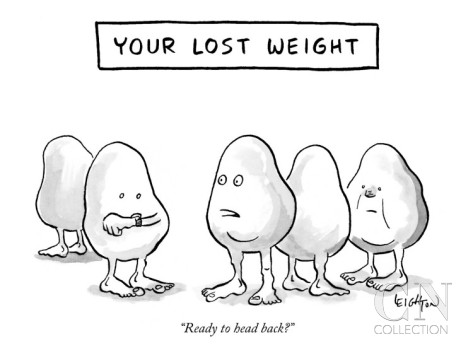
Ready to head back? Cartoon by Robert Leighton (2003)

So Oprah is on Weight Watchers. She recently bought WW stock, which then appreciated like gangbusters, so she has that going for her, which is nice.

I’m seeing a lot of posts chewing over this news, many with disappointment and general comments about the “impossibility” of losing weight. Even if you are Oprah, and rich, and capable, and surrounded by opportunities for help and support.

It’s not impossible to lose weight, but it’s difficult, frustrating, and draining to do things you dislike for reasons that are tied to sadness. If you are mired in a belief that “inside every overweight woman is the woman she knows she can be,” then your framing is your prison. Because if that woman is “inside” you, she IS you.

You can’t take good care of something you hate.

Acceptance in its various forms is often denigrated as passivity, as giving up, as the sweatpants and pint of ice cream of the soul. But sweatpants and ice cream are a perfectly enjoyable part of anyone’s life, and then you put them away, have a good night’s sleep, and get dressed for work and have an apple or whatever and life goes on. You can choose to make a habit of healthful living, and you can choose to make a habit of self-care and enjoyment, too.

Ultimately we are what we repeatedly do. If you keep punishing yourself for some notional failure, trying every 30-day fix out there in hopes something will stick, what will stick is restless program-hopping and the sense of failure. Give yourself the gift of walking away from that. Don’t try to change everything at once, but instead choose one small thing and practice it until you don’t have to think about it anymore. Then build on that track record of success.

“Ready to Head Back?” by Robert Leighton (2003)

“Move More” Is About More Than the Obesity Epidemic

doughty-lumbersexual

White men have been fretting about losing their *mumble*something* for at least 100 years. (Nitpick: I guess ‘lumbersexual’ is a play on ‘metrosexual,’ but it sounds too much like homo/bi/heterosexual to me, possibly because it’s so compatible with the hypermasculine archetypes in the gay community, so I keep thinking the lumbersexuals should be the ones lusting after these Bunyanesque figures.)

As silly as this particular instance is, I feel like this might have a useful connection to other conversations, like boys doing worse in school as more schools do away with recess and popular — and sometimes data — support for stereotypes like men being more likely to die doing something stupid.

As a society, we have recently been putting too much emphasis on sitting quietly (or at least being reasonably orderly) — first, explicitly, with public schools, designed as a method for pre-training a ready workforce, and even more so in the last century as the manufacturing economy gives way to cubicles as far as the eye can see. Women have an advantage in such constricting environments by being socialized to “go along to get along,” but it shouldn’t surprise us when men, who retain “boys will be boys” socializing in spite of these macro changes in our social environment, have more trouble “adjusting.”

I’m not advocating going along to get along — I think rejecting that expectation is healthy, and it’s explicitly a form of privilege to feel free to reject it. I feel like we are seeing a wide range of signs that are telling us we need to move more, do more hands-on activity, inhabit our environments more actively. Women, too! We just don’t have the handy stereotypes to model on.

The Atlantic article goes on to explain that the romance of the lumberjack image was deeply at odds with the hazardous and tenuous life of actual lumberjacks, especially as the industry expanded. Logging remains one of the most dangerous jobs in the United States, a lot of risk for barely $35k a year. This makes the appeal of the mythos greater, of course, rather than less — however you feel about logging today, the historic image is one of honest work to help build a growing nation. Even for people who also enjoy knowledge work, that is a powerful draw — getting up, getting your hands dirty, having a physical object to show for it, a feeling of righteous exhaustion, all in the service of something tangibly useful. You don’t have to wear plaid to split wood, and you don’t have to split wood to enjoy making things. We clearly yearn for more than cubicle life, so let’s make sure we get out more.

Dear Trainers, Please Stop

jen-sinkler-lwf
Jen Sinkler prefers actively planning her lifting routines to incorporate cardio conditioning, rather than splitting out cardio and lifting, and she has developed a host of circuits to help others get this all-around benefit, too. Similarly, cardio athletes (like me!) who choose heavily resistance-oriented sports like rowing and swimming combine our enjoyment of cardio with a great full-body strength workout.

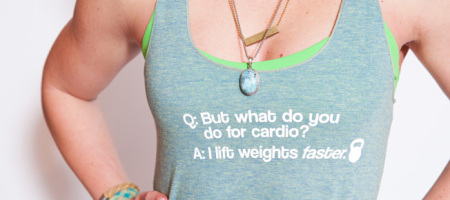
Please stop saying “No cardio, just lifting!”

Trainers who focus on resistance training like to use this as a sales pitch. Sometimes they even claim that cardio is harmful, but the more honest among them simply say, hey, cardio is not for everyone (and I’ll get to that later), so we’re just going to lift, because it’s just as good.

Here is the reality: when lifting is just as good as “cardio” for overall health, it’s because it includes cardio.

A good cardio (aerobic) base is, like a good strength base, essential to good human health. Both contribute to various aspects of health: respiratory health, hormonal balance, blood sugar stability, sleep regulation, bone density, mood regulation, and of course heart health — because who cares how good your nutrition is if your heart can’t pump the nutrients through your body?

How do you know you’re doing cardio? Listen to your heart. The aerobic exercise “zone” is estimated to be about 75% of your maximum heart rate, so roughly 140ish for many people. That’s a good place to be for healthful exercise, and roughly the level of effort where you can pass “the talk test” — have a conversation while exercising. You also get health benefit from any level of exercise around 100 heartbeats per minute or more. So wear a heart rate monitor and see what your average heart rate is during an activity you like to do for a half hour or so — like walking or a weights session at the gym. If it averages over 100, you’re doing cardio.

Some trainers will say, “I’m not talking about that! I’m talking about endless hours on the treadmill or elliptical! That’s cardio!” Look, I get it — you don’t enjoy that. I don’t either, for what it’s worth. But you don’t get to make a pile of things you don’t enjoy and call it “cardio.” Because cardio already means something. And not what its detractors say it means — which generally boils down to ineffective training combined with poor nutrition.

Triathletes and ultra-distance athletes, the ultimate cardio athletes, don’t just lean on treadmill rails for a half hour, read the machine’s calories-burned count, and go to Starbucks. And, no matter how much (or little) time you spend on exercise, neither should you. Mix it up — alternate a little faster and a little slower — and use your balance. Try different machines, if you like machines, or walk more during the day. Take a strength-training class. Heck, do a little bit of all of it. If you’re not a competitive athlete, the exact workout you do is much less important than being active — regularly — and being attentive to what you’re doing while you’re exercising. And eat right — that means protein, vitamin-rich foods, and enough. Undereating just leaves you run down, and tears down the important tissues you need for health.

Here are some examples of cardio:

  • Running
  • Swimming
  • Cycling
  • Rowing (sport or just in a rowboat)
  • Dancing
  • Walking
  • Climbing stairs
  • Flipping tires
  • Martial arts, from fencing to MMA
  • Gardening
  • A brisk lifting session in any strength disclipine
  • Yoga
  • Scrubbing floors
  • Shoveling snow
  • Calisthenics
  • Sled drags and sled pushes
  • Hiking
  • Canoeing
  • Skate-, surf-, snow-, or wakeboarding
  • Table tennis
  • Volleyball
  • Badminton

Don’t like running? Don’t run. Hate the elliptical? Don’t even look at it. Hate cardio? I doubt it. Almost every person I’ve heard say they “hate cardio” has also said — sometimes in the very same breath — that they love a good hard workout. And that’s cardio.

There is one thing that the more traditional cardio activities will do much better than just lifting weights faster (or with better management of rests), and that’s make you good at cardio activities. You won’t come away with from a brisk, athletic lifting-only program being able to run a fast mile or run for a half an hour straight. (Same way doing some basic strength training won’t turn you into a powerlifter.) This seems like a non-issue to me, but you will hear a lot of people list benchmarks like that as “what it means to be fit.” They’re wrong, too. That’s a particular form of performance, but basic fitness is really basic, and is not really defined by numbers of pushups, percent of bodyweight lifted on a barbell, or 3-mi run time. Advanced fitness is like any other kind of advanced example of something that fits well or is fitting: dependent on the context.

Basic strength and basic cardio conditioning are a foundation for health and for training performance, and it’s OK to prefer one and be “just OK” at the other. I sometimes wonder if that’s part of the sticking point for “no cardio, just lifting!” advocates — so many of them act as if every exercise has to count and has to be focused on a goal of excellence or at least progress, and they can’t tolerate the idea of doing something they aren’t good at and don’t want to take the time to be good at. So I’d like to offer another piece of advice that has been helpful to people training athletics for ages: leave your ego at the door.

It’s OK to have fun. It’s OK to do stuff you’re not great at. It’s important to eat your vegetables, and it’s even better if you can find vegetables — or recipes for them — that you really, deeply enjoy.

So how about a new pitch? One that has the advantage of reassuring people interested in strength training, that is not actually insulting to perfectly enjoyable other sports, and that, you know, describes what you’re offering? Get a great full-body workout with barbells! Or kettlebells, or whatever. It’s not that hard to just sell what you’re selling — instead of going out of your way to tear down something else.

When You See Someone You Find Unattractive

[Fat|scrawny|ugly|whatever] people shouldn’t be allowed to wear [bikinis|spandex|yoga pants|whatever].

If you find yourself thinking this, you can solve this problem once and for all:

Don’t like someone’s body? Stop looking at it.

So easy! One simple step that anyone can take. Try it today!

But I’m entitled to my opinion!

Yes, absolutely. So take responsibility for it. Own it. Say “I don’t like the way bikinis look on that body type.”

But that makes it sound like it’s just about me, like no one has to care.

Right again! No one has to care about your opinion of their body.

But it’s not just personal — it’s about standards. People should have some pride in their appearance, and not look like that.

Nope. Wrong. Nobody has an obligation to please you with their appearance. (Unless you are a Drill Instructor doing an inspection, I guess. Are you?)

This isn’t just about appearance! It’s about health. Those people aren’t healthy.

Ah yes, the “just trying to help fat people” defense. That may be true, but you don’t know, you don’t know whether they’re working to change that, and you don’t know what obstacles they’ve faced.

You’re probably [fat|ugly|scrawny|whatever], too!

Yeah, probably. There’s a lot of people in the world, and I’m sure there’s plenty I don’t appeal to. Plus, all those terms are moving targets — they don’t have consistent uses among different people.

Anyway, now you know what to do about it!

I wish I could, but …

What’s your excuse?

I have a love/hate relationship with this question. How does it help people to act like not “eating clean and training dirty” – or whatever someone is evangelizing right now – means they must be lazy whiners? Whenever we fail to do something we know we should do, but can’t seem to manage, there is a reason. Yes, there are some excuses, and some reasons are worse than others, but people who fail to act usually do detect a genuine obstacle of some kind. Here are some examples:

  • “Nothing works – I know, because I’ve tried a bunch of stuff.”
  • “Honestly I’m not sure how to start – everything I read says that I could get injured doing X or ‘ruin my metabolism’ doing Y. What to believe?”
  • “It’s truly a struggle to get up earlier, and by the end of the day I’m totally run down.”
  • “I have to work around an injury, and it’s frustrating on top of hard.”
  • “If I’m serious about getting in shape, I have to go to the gym 3 or 4 times a week, and I can’t make that commitment.”

None of these are very good reasons, but they are real. The fitness industry is chock full of bizarre claims and crazy promises, and high-circulation magazines are under pressure to offer simplistic answers with lots of variety – not harping on the tried and true every month. And there’s no money in the boring, yet effective, messages of better health, so even when health agencies and other groups try to get the information out, their efforts are underfunded.

Another complication: because people have such a wide variety of preferences and obstacles, it can be hard to know how to match them up with the information that will help them most. “I can’t seem to lose this pudge” could be down to very different needs:

  • How to tell the difference between snake oil and evidence-based recommendations – or even get just a base of good health information
  • How to start small, as with simple home exercises that will put them on the right track – and help give them the energy to try more
  • How to find a gym that is convenient to home or work – or even how to choose a gym in the first place
  • How to keep good track of what they are eating – enough information to make good decisions and easy enough to stick with
  • How to exercise in a way that supports their goals without making them feel like they are being punished

If those high-circulation magazines thought deeply about all the different details that go into the millions of ways to combine healthy food and different forms of exercise, they’d never run out of truly useful information to share. But it still couldn’t be teased as well on the cover as “DROP A DRESS SIZE IN 7 DAYS,” “KILLER ABS,” or “BUILD A BUTT THAT DEFIES GRAVITY.”

The next time you catch yourself thinking, “Ugh, this person should just get out of a chair once in a while,” try asking something simple, like, “Well, what’s the toughest hurdle to getting started?” You may be able to help them figure out something that now seems so second-nature to you that you’ve forgotten that you had to learn it somewhere, too.