Category Archives: Words

Complexity Is Alive and Well

Clay Shirky’s essay, The Collapse of Complex Business Models, has been making the rounds. I was turned off early by a breezy comparison of large companies to sclerotic ancient civilizations, but he really lost me at

The most watched minute of video made in the last five years shows baby Charlie biting his brother’s finger. (Twice!) That minute has been watched by more people than the viewership of American Idol, Dancing With The Stars, and the Superbowl combined. (174 million views and counting.)

But that’s not true, as a 30-second Google search reveals. At the most charitable estimate, it’s neck and neck with a Lady Gaga video. Since Lady Gaga came to prominence about 8 minutes ago, and the Charlie video has been online for 3 years, I don’t find this claim compelling. (Yes, I get the Web-vs-TV point—I’m not even bothering to look up those numbers—but the argument is also about simplicity vs high production values.)

But whatever. Shirky gets lots of attention and consulting gigs and book deals and so on, so obviously he’s reaching audiences very effectively. I have a full-time day job, and I’m trying to stay faithful to my goal of taking at least one good picture of an animal every day this month (doing well!), so I left it at that.

And then a friend shared a link to Wikibollocks: The Shirky Rules, by Tom Slee. It goes into some detail about this recent essay, adds considerable depth to my main loss of connection with it, and compares it to other work by Shirky.

Then again, that Shirky article was posted on April 1. Should I be embarrassed right now?

Update June 2010: Another article critical of Shirky’s methodology

Pope Could Cancel UK Visit

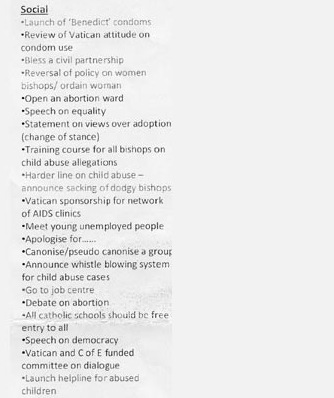
The Pope could cancel his planned visit to Britain because of a “hugely offensive” Foreign Office memo mocking his stance on abortion and birth control. I am trying to understand why this would be a bad thing.

Here’s the image of the claimed memo, published by the Telegraph.

pope2_1623149a

I was expecting a whole list like the condom item, but many of these are serious issues on which the world’s Catholics are diverging further and further from their leadership. Why shouldn’t these issues be on the agenda for a visit by the Church’s leader to a modern, civilized nation?

In text format:

  • Launch of ‘Benedict’ condoms
  • Review of Vatican attitude on condom use
  • Bless a civil partnership
  • Reversal of policy on women bishops/ordain woman
  • Open an abortion ward
  • Speech on equality
  • Statement on views over adoption (change of stance)
  • Training course for all bishops on child abuse allegations
  • Harder line on child abuse—announce sacking of dodgy bishops
  • Vatican sponsorship for network of AIDS clinics
  • Meet young unemployed people
  • Apologize for…
  • Canonise/pseudo canonise a group
  • Announce whistle blowing system for child abuse cases
  • Go to job centre
  • Debate on abortion
  • All catholic schools should be free entry to all
  • Speech on democracy
  • Vatican and C of E funded committee on dialogue
  • Launch helpline for abused children
  • Why is the UK so eager to make nice with someone who heads an organization with so much to answer for?

    Business Models Are Hard

    Look, let’s face it. The iPad is the most exciting opportunity for the media in many years. But if the press is ceding gatekeeper status, even if it’s only nominally, over its speech, then it is making a dangerous mistake. Unless Apple explicitly gives the press complete control over its ability to publish what it sees fit, the news media needs to yank its apps in protest.

    Yes, this is that serious. It needs to wrest back control of its speech from Apple Inc.

    It’s Time for the Press to Push Back Against Apple:
    Yank iPad apps unless Apple cedes complete control over the right to publish, by Ryan Chittum

    In an aside, he includes, “yes, the iPad has a Web browser, but the monetary leverage it could gain with apps is what’s concerning.”

    Getting the App Store dropped into its lap is the best thing that’s happened to print media in decades, and arbitrary restrictions are a pretty good deal in exchange for access to hundreds of millions of accounts already set up for more or less one-click purchasing. Yanking apps because you don’t like the restrictions is a perfectly fine recommendation, but I’m not sure what kind of leverage print media really has that would allow it to dictate terms to Apple. Face it, media outlets: building a large base of users that keep active credit cards on file with you is hard work, and Apple—not you—succeeded in doing that work.

    (As a matter of fact, no, I don’t think I’m entitled to get news for free. I am a longtime subscriber to quite a few websites.)

    Update: Jobs has replied to an inquiry saying that the Fiore app-denial was a mistake that is being fixed. Which is fine—maybe the terms of service were meant to apply to harassment or defamation, or came from an overprotective pen in legal. Maybe Jobs is responding to the “Pulitzer” part of this story. Who knows. The point stands: it’s Apple’s store, not a First Amendment issue.

    Homeopathy in the United States

    Homeopathy is more prominent in Europe than it is in the United States. In the United Kingdom, for example, the Royal Family has long used homeopathic remedies, and the Prince of Wales advocates for the practice. Homeopathy is also paid for under the UK’s National Health Service (as it is by several other national health services in continental Europe), although the UK House of Commons Science and Technology Committee has recommended that this be reviewed.

    In the United States, some states license homeopathic providers along with other groups, such as chiropractors, but Medicare, the largest single payer in the United States, rejects charges for homeopathic treatments as “not medically necessary.” Some private health insurance plans cover homeopathy under modest “complementary medicine” benefits, such as Blue Cross plans offering a small annual maximum benefit ($500) for alternative services such as homeopathy, herbal medicine, ayurvedic treatments, or naturopathy. But private insurances often limit such benefits with a cap on numbers of visits and a deductible that is even higher than the maximum benefit.

    The US Food and Drug Administration recognizes homeopathic remedies for marketing, but concerns itself mainly with their presence in the homeopathic register and with details of labeling. (The FDA lightly monitors a number of treatments that were already common before it began its assessment programs.) FDA exemption of homeopathic remedies from expiration dating and other labeling requirements reflects the safety (lack of toxicity) of compounds without active ingredients. The FDA has published information for consumers about homeopathy in the past, but its current FDA For Consumers website does not return any results for searches on homeopathy.

    The US National Institutes of Health has recently begun complementary medicine programs, including funding some studies to test complementary treatments. Its NCCAM (for complementary and alternative medicine) program is controversial in some quarters, criticized as promoting worthless therapy. But it publishes fairly straightforward (ok, yeah, a little bit too “neutral”) information about homeopathy, the general thrust of which is that the efficacy of homeopathic drugs is not established, but the placebo effect can be helpful. For people considering using homeopathic remedies, the NCCAM’s very first recommendation is, “Do not use homeopathy as a replacement for proven conventional care or to postpone seeing a doctor about a medical problem.”

    If this all seems a bit dull and plodding, then I confess: that’s how it feels to me. Homeopathy has never been particularly visible in my life, even though I live in the Sam Francisco Bay Area and understand that this area is home to many medical denialists—people who don’t want to vaccinate their children, for example, or who swear by raw milk as not merely safe but universally beneficial. These are educated, middle-class people who are simply privileged enough that they (and their parents) can’t remember a time when vaccine-preventable diseases stalked the land in great numbers, let alone the way that the increasing urbanization of Americans created a special challenge for distributing milk safely over longer distances. Still, as foolish as privileged people are willing to be on their own dimes, it seems like the people writing the checks and making the standard-of-care recommendations are on the right page with this one.

    Tomorrow, I promise, I’ll link to something tart and British on the subject.

    (If you can’t wait [for tart and aren’t holding out for British], then go to YouTube and watch this bit from Dara O’Briain on alternative medicine. He’s a bit harsh about “nutritionists,” which here are as likely to be mainstream providers working side by side with physicians in diabetes and genetics clinics, but he’s certainly got homeopathy pegged.)

    Homeopathy on Horizon and Beyond

    In 2002, BBC’s Horizon television show actually conducted experiments in homeopathy, aiming for James Randi’s Million-Dollar Challenge. (The episode is available in 5 parts on YouTube—the video above is part 1; Horizon’s attempt is reported in Part 5.) The Challenge was first introduced in 1964 when James Randi offered $1,000 of his own money to the first person who could offer proof of the paranormal. Donors stepped forward to sweeten the pot, and Randi maintains a public log of attempts to win the prize. I hope I’m not spoiling the Horizon episode when I report that no one has won.

    Don’t have time for the BBC Horizon episode? Here’s the homeopathy sequence from Richard Dawkins’s 2007 documentary, Enemies of Reason (less than 10 minutes):

    That’s popular science, on television. Have there been more recent high-visibility examinations of homeopathy in the UK? Oh yes. This year, the UK House of Commons Science and Technology Committee published its Fourth Report, Evidence Check 2: Homeopathy. Its conclusion:

    We conclude that the principle of like-cures-like is theoretically weak. It fails to provide a credible physiological mode of action for homeopathic products. We note that this is the settled view of medical science.

    In our view, the systematic reviews and meta-analyses conclusively demonstrate that homeopathic products perform no better than placebos.

    We regret that advocates of homeopathy, including in their submissions to our inquiry, choose to rely on, and promulgate, selective approaches to the treatment of the evidence base as this risks confusing or misleading the public, the media and policy-makers.

    We accept that NICE [UK’s department for evaluating treatments and recommending or rejecting them for coverage by the national health service] has a large queue of drugs to evaluate and that it may have greater priorities than evaluating homeopathy. However, we cannot understand why the lack of an evidence base for homeopathy might prevent NICE evaluating it but not prevent the NHS spending money on it. This position is not logical.

    For patient choice to be real choice, patients must be adequately informed to understand the implications of treatments. For homeopathy this would certainly require an explanation that homeopathy is a placebo. When this is not done, patient choice is meaningless. When it is done, the effectiveness of the placebo—that is, homeopathy—may be diminished. We argue that the provision of homeopathy on the NHS, in effect, diminishes, not increases, informed patient choice.

    We conclude that placebos should not be routinely prescribed on the NHS. The funding of homeopathic hospitals—hospitals that specialise in the administration of placebos—should not continue, and NHS doctors should not refer patients to homeopaths.

    People often say they like their homeopathic provider because that provider takes time and listens to them. The placebo effect can, after all, be very noticeable, even genuinely helpful. It’s an area that deserves better understanding—in part because techniques that leverage the placebo effect could easily be combined with science-based treatment in a way that improves care without misleading patients:

    Homeopathy Awareness Week

    I’d like to kick off Homeopathy Awareness Week with some remarks from Oliver Wendell Holmes—physician, writer, and father of the Supreme Court justice of the same name—from his 1842 essay, “Homeopathy and Its Kindred Delusions.”

    Those kind friends who suggest to a person suffering from a tedious complaint, that he “Had better try Homoeopathy,” are apt to enforce their suggestion by adding, that “at any rate it can do no harm.” This may or may not be true as regards the individual. But it always does very great harm to the community to encourage ignorance, error, or deception in a profession which deals with the life and health of our fellow-creatures….

    To deny that good effects may happen from the observance of diet and regimen when prescribed by Homoeopathists as well as by others, would be very unfair to them. But to suppose that men with minds so constituted as to accept such statements and embrace such doctrines as make up the so-called science of Homoeopathy are more competent than others to regulate the circumstances which influence the human body in health and disease, would be judging very harshly the average capacity of ordinary practitioners.

    To deny that some patients may have been actually benefited through the influence exerted upon their imaginations, would be to refuse to Homoeopathy what all are willing to concede to every one of those numerous modes of practice known to all intelligent persons by an opprobrious title.

    So long as the body is affected through the mind, no audacious device, even of the most manifestly dishonest character, can fail of producing occasional good to those who yield it an implicit or even a partial faith. The argument founded on this occasional good would be as applicable in justifying the counterfeiter and giving circulation to his base coin, on the ground that a spurious dollar had often relieved a poor man’s necessities.

    More about the struggles of different approaches to health and wellness in the 19th Century in the National Library of Medicine’s feature “So, What’s New in the Past? The Multiple Meanings of Medical History.”

    Science and Religion

    From an interview with John Cook, the creator of the Skeptical Science blog.

    Q. What is your scientific background and/or interest or activity in the environmental arena?

    A. I studied physics at university and majored in astrophysics in my post-grad honors year. After completing my studies, I went into real world (a sorely needed break from academia) and I’ve been working from home for just over a decade now. I’ve never been involved in environmentalism before. To be honest, I’m not sure I’d characterize myself as an environmentalist now. While I got into global warming out of scientific curiosity, my continued interest and all the hours I spend on it are more out of concern for humanity than nature. I’m a Christian and a strong aspect of my faith is social conscience – hating injustice and caring for the poor. As I pored through the research into global warming impacts, I learned that poor and developing countries are those worst affected by global warming. Ironically, these are the countries least able to adapt to climate change.

    (It may help his sense of urgency that he is Australian, where almost the entire population lives within an hour’s drive of the coastline.)

    Cook has also produced an iPhone app called Skeptical Science, which contains a list of arguments against standard anti-global-warming talking points.

    Doggie Tao

    Ideally, I have tea on my roof with Morgan. Morgan lives a few doors down from me. He has three little dogs. I don’t know what they are. They are the most amazing creatures on the planet. If there is a tennis ball, it’s the most awesome tennis ball they have ever encountered. If it’s a piece of Kleenex, it’s the most awesome Kleenex. Dogs have boundless enthusiasm but no sense of shame. I should have a dog as a life coach.

    From last month’s Sunday Routine article about Moby.

    iPad Hate

    I’m a little amazed by the iPad hate. It’s quite a few of the usual suspects, so it’s not necessarily surprising. The iPad doesn’t have enough ports, or it needs a stylus — there are plenty of angsty laments from people who’ve watched Win-based tablet after Win-based tablet fail to gain any traction at all. My gut reaction to them is that they haven’t given any thought to why Apple went in a different direction, and those people are generally not buying any Apple products, so there’s no reason to expect them to welcome this one.

    But with the iPad, Apple critics have been joined more vociferously than usual by (perpetually) disappointed Apple true believers, who have always had a hard time seeing where their devoutest wishes end and Apple’s real-life product development begins. That the iPad will transform all who touch it into DRM-constrained consuming machines. That having to go through the app store will destroy innovation. That it will kill communication. What? No, really?

    Were today’s iPad contrarians outraged that when the Sony Reader was released, you couldn’t write a book with it? Do any developers of smartphone applications do all their design, prototyping, and coding using a smartphone as their primary work environment? I don’t take hi-res macro photos with my laptop, and I don’t color correct, generate multiple file formats, and manage photo libraries on my SLR camera. Just because a device has a computer inside doesn’t mean it has to do everything, or even be elaborately customizable and configurable.

    A low barrier to entry is the single best hook for nascent makers, but iPad critics are simultaneously condescending and overdemanding about what constitutes a barrier and what constitutes creativity. With my photography, for example, what I want from computer-based devices is anything that enables me to better pursue my photography. I do not care about my computer’s schematics. I do not care about exploring programming. Somehow I find it hard to believe that this attitude toward tools is killing my creativity. And the iPad supports a text editor. Let me remind iPad haters: a text editor is all you need to build a website.

    General-purpose devices can encompass novice-level tools with ease, but once the novice is hooked and has to know more, he or she moves on to different tools. Not only will the iPad refrain from killing creativity or communication, but Apple will continue to make and improve flexible, powerful tools that enable people to create stuff that can be used and displayed on the iPad. As with the iPhone, developers are already making apps for the iPad, some that focus entirely on display and others that will enable creativity and communication. And of course, the iPad itself will develop, getting new features and capabilities — Apple’s track record is crystal clear on this path.

    The iPad is not Jesus. It is not the Devil. It will not rescue magazines, and it will not enslave users. It is a device, a tool whose major defect is that people outside its development team are projecting too much of their own fantasies onto what it can — and can’t — do.